


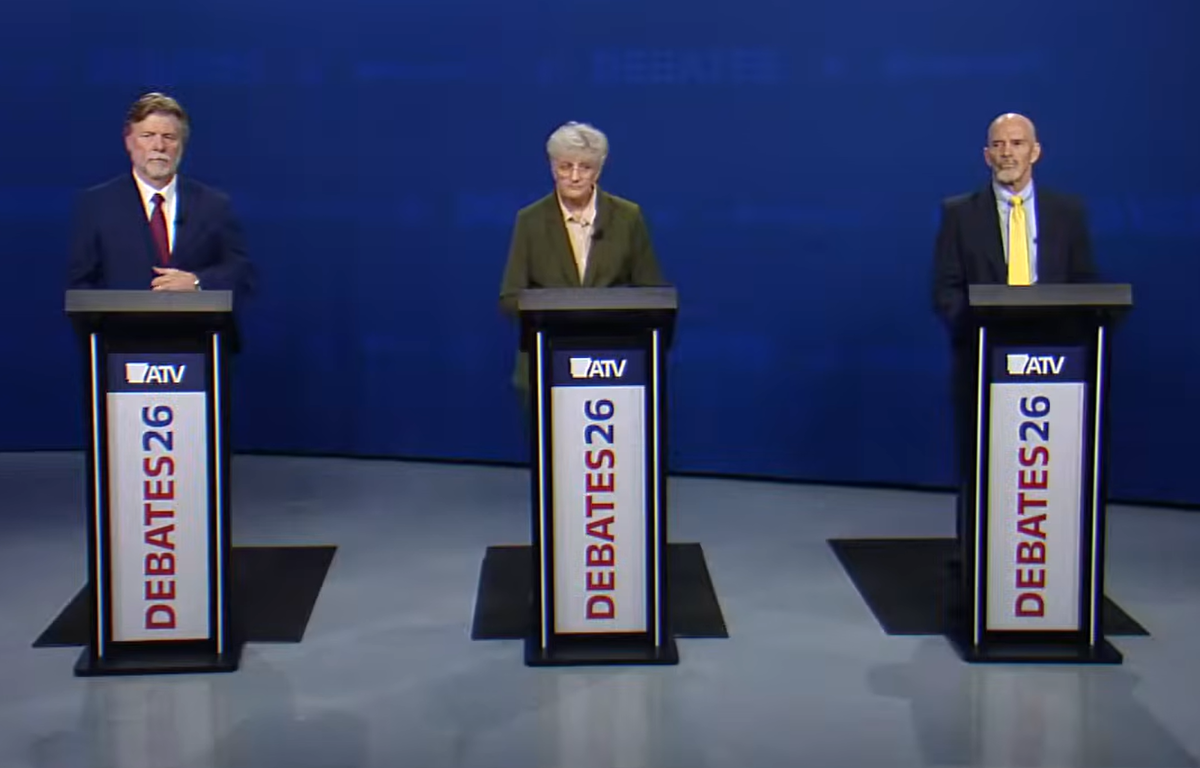

Little Rock, AR – Jonesboro Right Now – Candidates vying to represent Arkansas in U.S. Congressional District 1 laid out contrasting visions over foreign military entanglements, global tariffs, and the district’s rural infrastructure crisis during a debate Wednesday.
The Arkansas TV debate featured Republican incumbent Rick Crawford, Democratic nominee Dr. Terri Yarbrough Green and Libertarian nominee Steve Parsons. Green and Parsons had previously debated for the race on ASU-TV earlier this month with Crawford being absent.
The broadcast was moderated by a panel of journalists that included Andrew Bagley of Helena World; Diana Davis of K8 News; and George Jared of Talk Business & Politics.
As per the debate rules, the candidates were given one minute to answer each question, 30 seconds for rebuttals, and one minute for closing remarks. The speaking order was established prior to the broadcast via a number drawing.
Use the following links to jump to a specific topic.
| ADD US ON GOOGLE NEWS: Click here to see more local news from Jonesboro Right Now
Foreign Policy, Middle East Conflicts, and the War in Iran
The debate moved to international affairs when panelist Diana Davis asked the candidates about the ongoing war in Iran, the disruption of Red Sea shipping lanes by Houthi rebels, and how these distant conflicts directly impact local farmers and consumers through increased costs.
Crawford defended the United States’ military actions, framing the conflict as a necessary measure against Iranian regional aggression, ballistic missile threats, and the country’s nuclear ambitions.
While acknowledging the economic toll the conflict takes on domestic supply chains, Crawford argued that the geopolitical risks justify the involvement.
“Nobody wants to pay this price, but we also don’t want a nuclear-armed Iran,” Crawford stated. The exchange grew particularly heated when Crawford addressed Parsons’s criticisms regarding Israel, stating pointedly, “I’m not antisemitic like the gentleman on the end here”.
Parsons aggressively rebuffed Crawford’s accusation, centering his foreign policy stance on ending unilateral military actions and halting foreign lobbying influence, specifically calling out the acceptance of AIPAC money.
Parsons argued that the United States needs “to stop being the puppet of Israel” and end the war in Iran to restore the flow of affordable fuel and fertilizer to American farmers. Defending his criticisms of the conflict’s civilian casualties, Parsons asserted that his position “is absolutely not an antisemitic statement, but it is a statement about Israel”.
Green criticized the execution of the conflict, focusing on the separation of powers and arguing that the United States entered the war unilaterally without proper legislative approval.
“I think this war was started on a whim and it was not initiated, like the Constitution insists, agreed upon by Congress,” Green said.
While Green agreed that Iran poses a genuine threat—primarily to Israel—she suggested that the current administration’s approach was heavily swayed by Israeli Prime Minister Benjamin Netanyahu. She further noted that other global powers have opted for diplomatic routes because they understood the economic devastation that would result if Iran closed the Strait of Hormuz.
Agriculture, Rice Imports, and International Trade
Panelists George Jared and Diana Davis pressed the candidates on the critical challenges facing Arkansas agriculture, noting that up to 25% of the state’s farms have shuttered over the last 18 months, foreign competitors continue to heavily subsidize rice imports, and a comprehensive Farm Bill has stalled in Washington since 2018.
Crawford defended the lower chamber’s efforts, pointing out that his colleagues had already acted on the legislation.
“Yeah, we actually passed a farm bill out of the House back in June,” Crawford noted, adding that they are currently “waiting on the Senate to take action”.
Crawford highlighted specific relief measures championed by his office, including adjusting reference prices for Price Loss Coverage (PLC), which he called “the most critical safety net support that they receive here in East Arkansas,” to ensure baseline supports reflect current market costs rather than outdated 2012 figures.
Defending targeted trade enforcement against subsidized Indian and Thai rice, Crawford insisted that tariffs remain a viable economic defense: “Tariffs themselves are not inherently bad or good. They are a tool, and in this case could be used to provide some relief to farmers”.
Green agreed that the Farm Bill must be finalized but pointed to broader safety-net disputes behind the legislative gridlock.
“My understanding is that it is being held up in the Senate because many of the Senate Democrats are wanting to include a repeal of the Medicaid and SNAP cuts,” Green explained. While agreeing those cuts should be undone, she urged that they be separated so agricultural relief can pass cleanly.
| READ MORE: The latest regarding election races and issues in Craighead County
On trade, Green supported targeted rice tariffs but warned that family farms face an even larger structural threat from corporate consolidation.
“One of the other problems with just farming, our farmers in general, is consolidation of ag, Big Ag,” Green said, urging Congress to enforce antitrust laws to restore market competition.
Parsons diverged completely from both opponents, arguing against the foundational premise of federal farm subsidies and broad tariffs.
Pointing to 2025 numbers, Parsons noted that roughly 45% of farm revenues stemmed directly or indirectly from government subsidies, creating distortions where taxpayers end up “subsidizing people eating rice in Mexico”. He advocated for a total phaseout of federal agricultural subsidies modeled after New Zealand’s 1984 deregulation, coupled with regulatory repeals of the Jones Act and biofuel mandates to lower overhead.
Parsons also warned that broad tariffs function as a direct burden on domestic buyers: “Tariffs are attacks. It’s a tax on American businesses… 95% of that tax is going to be passed on to consumers”.
Rural Infrastructure, the Helena-West Helena Water Crisis, and Broadband
Panelist Andrew Bagley directed the candidates to the severe physical and digital infrastructure deficits facing rural Arkansas, pointing specifically to the acute crisis in Helena-West Helena, where half the city went without running water for two weeks, and asking how the candidates would prioritize federal investments and whether they would pursue congressionally directed spending for such projects.
Parsons cautioned that heavy federal infrastructure spending often misallocates taxpayer dollars and rarely solves local management problems.
“In terms of the kinds of money that the federal government spends, infrastructure is better than the vast majority of the money that Congress does spend,” Parsons acknowledged, but emphasized that “a lot of that, I think, is in fact a state and local kind of an issue”.
Pointing to the expansion of rural high-speed internet, Parsons drew from his professional background in broadband mapping to warn about runaway federal costs.
“As you try to push broadband farther and farther out into the rural areas, the costs become increasingly high,” Parsons observed, noting that for the most remote properties, the price tag can escalate to “$10,000 to $20,000 per home passed”.
In his rebuttal, Parsons argued that municipal breakdowns like West Helena’s are fundamentally leadership failures that outside federal spending cannot fix on its own.
Crawford placed the blame for Helena-West Helena’s chronic water system breakdowns on entrenched municipal mismanagement rather than a lack of federal goodwill.
“We’ve been hands-on in the community in Helena-West Helena on this water issue for literally years,” Crawford said, “and you can solve this problem with simple leadership change, quite frankly”.
Crawford explained that his office had repeatedly mobilized resources and attempted to facilitate regional partnerships with other water operators across Phillips County, only to see local officials disengage: “I’ve set up meetings and attended those meetings myself and had the mayor decline to attend, even though we set them up on his behalf”.
Turning to rural broadband during his rebuttal, Crawford argued that previous federal efforts had been “overly prescriptive” by exclusively mandating fiber-optic cable.
“It didn’t account for whatever technology might come in years to come,” Crawford noted, suggesting that satellite alternatives like Starlink offer a faster, more cost-effective way to deliver the “last mile” to underserved rural residents.
Green argued that federal investments remain an indispensable lifeline for distressed towns that cannot finance modernization on their own.
Green highlighted recent federal investments flowing into the district via the Bipartisan Infrastructure Law, citing Luxora’s use of a $10 million grant to construct a new water tower and replace aging lines. However, Green stressed that structural barriers often block the poorest municipalities from receiving aid.
“In some instances, the grants that are available require matching funds,” Green said. “Many of these very small communities do not have a tax base to be able to have matching funds, and some grants need to be available that don’t require matching funds”.
In her rebuttal, Green reiterated the critical impact of direct federal dollars for utilities and high-speed internet, reminding voters that “the Biden infrastructure bill has provided excellent finances for good infrastructure that has occurred… and that the incumbent did vote against it”.
Military Justice and the Nidal Hasan Execution
Editor’s Note: This debate took place a day before President Donald Trump announced that the firing squad execution of Fort Hood shooter Nidal Malik Hasan would not take place following bipartisan criticism, the Associated Press reported.
The debate took a sharp turn into national military policy when panelist George Jared asked the candidates about the upcoming Dec. 3 execution of Nidal Hasan, the former Army psychiatrist convicted of killing 13 people and injuring 32 at Fort Hood in 2009. Specifically, Jared asked whether the execution—which the Pentagon recently announced will be livestreamed—should be broadcast, and if doing so risked turning Hasan into a martyr.
Parsons used the question to outline his blanket opposition to the death penalty.
“The Libertarian Party’s position is they’re against the death penalty,” Parsons said, noting that if an execution is egregious enough, he personally does not mind it, but “as a practical matter… the death penalty, I’d say we don’t need to do the death penalty in general… simply because it’s so expensive”.
He pointed out that the extended legal appeals process often costs the government between $1.5 million and $2 million extra compared to lifetime incarceration. Addressing the prospect of livestreaming the firing squad, Parsons said, “I find the livestreaming a little bit repugnant personally”.
Crawford approached the issue through the lens of the military justice system, noting that Hasan’s actions took place on a federal installation and involved military personnel.
“This is 100% a federal issue,” Crawford said, affirming that the uniform code of military justice was correctly applied and that Hasan, who has been incarcerated since 2009, is “scheduled to be executed on December 3rd”. However, Crawford forcefully opposed the Pentagon’s decision to livestream the event.
| READ MORE: The latest regarding election races and issues in Craighead County
“I think it has the potential as you suggested to possibly motivate extremists or further motivate extremists that might seek to do us harm,” Crawford warned, adding that while there are provisions for victims’ families and reporters to observe the execution, broadcasting it publicly could be exploited for extremist propaganda.
Green aligned with both challengers in her opposition to the broadcast, delivering a stark condemnation of the concept.
“I am 100% against livestreaming this. That is… that is not… that is horrid. It is wrong, it is disgusting,” Green said. She agreed with Crawford that the broadcast could inspire violence, noting that such public displays are “what the jihadists do”.
Green also expressed her broader opposition to capital punishment, echoing Parsons’s concerns about financial costs but adding a moral argument regarding the severity of the sentence.
“I think incarcerating people if they’ve committed a heinous crime, incarcerating them for the rest of their lives is more punishment actually than death,” she concluded.
Rural Healthcare and Hospital Solvency
The discussion then turned to the precarious financial state of rural hospitals across eastern Arkansas, focusing on inadequate Medicare and Medicaid reimbursements and the closure of essential services like maternity wards.
Green, speaking from her perspective as a physician, painted a stark picture of the healthcare landscape, noting that rural hospitals are consistently closing under current policies. She pointedly criticized the incumbent’s track record on the issue, arguing that conditions have steadily deteriorated.
“The incumbent has had 16 years to do something about these problems,” Green said. “They have only gotten worse. And I hope tonight to draw a distinction between what the incumbent has and has not done”. She strongly advocated for expanded federal support and criticized proposed legislative cuts that would further strain local healthcare safety nets.
Parsons offered a different diagnosis, pointing to the structural inefficiencies of federal matching grants and the burden of medical malpractice fears.
Parsons recommended converting Medicaid funding into block grants—providing states with a fixed sum of federal money to manage locally—and eliminating bureaucratic hurdles like certificate of need requirements. He also identified tort reform as a critical missing piece to lowering healthcare costs.
“A lot of medical procedures are done because the medical professional is concerned about lawsuits,” Parsons argued, adding, “And this is, let’s be clear, the United States is the lawsuit capital of the world”.
Crawford forcefully pushed back against accusations that he supported slashing Medicaid, framing his position as an effort to ensure long-term solvency.
“What we’ve been trying to do is prevent spending a trillion dollars a year and lower the trajectory on Medicaid spending so we can reduce costs and deliver better value to Arkansans who need help,” Crawford explained.
Crawford placed the blame for struggling rural hospitals directly on the Affordable Care Act, arguing that the policy’s framework stifles the private market because insurers refuse to reimburse providers at rates higher than those set by the federal Centers for Medicare and Medicaid Services.
“That’s what’s killed private insurance, and that’s why those hospitals are suffering,” Crawford said.
Closing Statements
In their one-minute closing remarks, the three candidates offered contrasting final appeals to voters.
Crawford emphasized his record and military background, framing his 16-year tenure as accountable stewardship.
“Public service is a responsibility, it’s not an entitlement,” Crawford said. Reflecting on the direct local impact of decisions made in Washington, he concluded, “I know that there’s an awful lot of work to be done, but the things that I’ve learned there are judgment and discretion matter, and integrity matters”.
Parsons urged voters to break the mold, noting that even a modest third-party showing could shake up politics.
Pointing to voters frustrated by overseas conflicts, tariffs, inflation, and federal spending, Parsons argued, “If you believe that you can run your life better than the federal government, we can send a message. You can vote for me… and that message will be: Congressman, enough is enough”.
Green contrasted her clinical career with professional politics, telling viewers, “I am a pathologist, not a politician. I’m still more comfortable behind a microscope than a microphone”.
Arguing that kitchen-table economic hardships and farm closures have worsened during the incumbent’s 16 years in office, Green called for congressional leadership willing to challenge executive overreach and directly address the economic pain felt by everyday Arkansans
During the hour-long broadcast, the candidates also debated solutions for widespread U.S. Postal Service delays, federal support for workforce training at community colleges, and the constitutional balance of executive power.
You can watch the debate below and catch future debates on Arkansas TV’s YouTube channel.
| DAILY BRIEF: Sign up for the Jonesboro Right Now Daily Brief Newsletter