


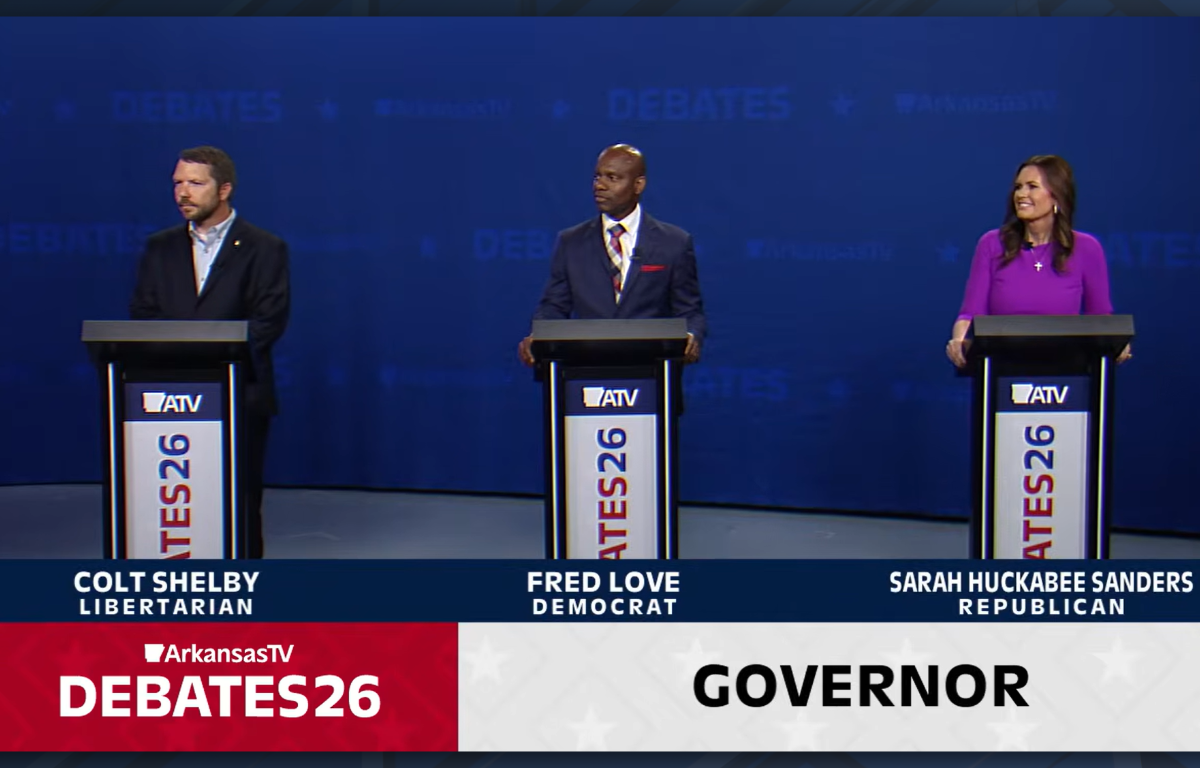

Little Rock, AR – Jonesboro Right Now – All three candidates for Arkansas governor took the stage together during Arkansas TV’s Debate Week, highlighting their differences over the direction of the state.
Tuesday’s debate featured Republican incumbent Gov. Sarah Huckabee Sanders, Democratic nominee Fredrick Love and Libertarian nominee Colt Shelby. The broadcast was moderated by a panel of journalists that included Steve Bronner, an independent journalist; Diana Davis of K8 News; and George Jared of Talk Business & Politics.
As per the debate rules, the candidates were given one minute to answer each question, 30 seconds for rebuttals, and one minute for closing remarks. The speaking order was established prior to the broadcast via a number drawing.
Use the following links to jump to a specific topic.
| ADD US ON GOOGLE NEWS: Click here to see more local news from Jonesboro Right Now
Medicaid Expansion and the ARHOME Waiver
The opening exchange centered on federal healthcare policy after panelist Steve Bronner questioned how the state should respond to the Trump administration rejecting Arkansas’s request to renew the federal Medicaid waiver for the ARHOME program.
Shelby opened the responses by criticizing state leaders for a lack of forward planning, arguing the administration waited four years and hoped for an extension rather than putting a backup strategy in place.
Shelby turned attention toward the Community Support (CES) waiver program, noting that families across Arkansas have faced long waits without clear answers from the Department of Human Services (DHS).
“Steve, the reason I’m here today is to fix these problems,” Shelby said.
| READ MORE: Northeast Arkansas Hospitals Prepare for Another Financial Squeeze as Medicaid Changes Loom
Love emphasized the origin of Arkansas’s Medicaid expansion, recalling that the state initially embraced the program under the Affordable Care Act because rural hospitals were on the verge of bankruptcy due to uncompensated care.
Love pledged to negotiate with the federal administration to protect coverage, but insisted the state must invest its own resources directly into hospitals to prevent facility closures and preserve local quality of life.
“It is imperative that Arkansas actually invest in their hospitals so that we can ensure that our hospitals stay open,” Love stressed. “We cannot have a good quality of life for Arkansans if we do not have our hospitals open. That’s what I will be doing for the people of Arkansas.”
In his rebuttal, Love turned to maternal and child wellness outcomes, pointing out that “in 2018 we had 2.2 infants not covered; now we have 7.6% of our infants not covered in Arkansas.”
Sanders defended the administration’s record, characterizing the ARHOME program as one of the critical priorities for the upcoming legislative session. She framed the debate around work, personal independence, and government efficiency. She argued that the goal of welfare “shouldn’t be that you stay there forever.”
“The goal should be to help move people off of that program, provide assistance while they need it, and get them back on their own two feet.” She added, “I think it is outrageous that somebody should be able to confiscate your hard-earned tax dollars simply because they choose not to work.”
Sanders also highlighted that the state has secured over $209 million from the federal government to bolster rural healthcare access and maternal health infrastructure.
Maternal and Rural Healthcare Access
Discussion on healthcare quickly turned to the state’s maternal mortality rates and rural health outcomes.
Love directly addressed the gap in care for new mothers, stressing that Arkansas remains an outlier without a full 12 months of postpartum Medicaid coverage. He stated that expanding investment in maternal healthcare is an essential step to protecting both infants and mothers across the state.
“If we want to care about healthy babies and healthy moms, that is a program that we will invest in to ensure that our moms are healthy,” Love argued.
Shelby agreed that the state has a severe problem, but criticized the administration’s delayed response to the crisis.
“The governor’s absolutely right… we’ve got a problem and this problem has been here for four years,” Shelby said. “And now we’re just now trying to think that it’s important.”
Highlighting the state’s mortality statistics, Shelby pointed out, “We lose eight out of every thousand babies born.” He further challenged the state’s political framing, arguing, “We want to claim to be a pro-life state but we’re a pro-birth state.”
Shelby emphasized the economic burdens placed on new mothers, noting that “the electricity is too damn expensive, the water’s too damn expensive,” and advocated for solutions like the “Montana model” to help families secure jobs and affordable daycare.
| READ MORE: The 60-day cliff: Inside the debate over Arkansas’s postpartum Medicaid limit
Sanders underscored the steps taken by her office, pointing to the launch of the “Healthy Moms, Healthy Babies” initiative, which she stated targets $45 million annually to improve maternal health outcomes and fund awareness campaigns. She framed the issue as deeply personal.
“As the only mother standing up here… I know how hard it is, even when you have access to great resources, how hard it is to be a mom,” she said. “We have to do a better job providing wrap-around services.”
Sanders highlighted the severity of the issue by noting that out of 35,000 pregnancies in the state each year, “1,100 of those women never see a doctor until they are in labor.”
The LEARNS Act and Public Education
The sharpest divides of the night emerged when panelist Diana Davis shifted the conversation to the LEARNS Act, questioning the accountability and fairness of using public taxpayer dollars to fund private school tuition without requiring the same standardized testing or public reporting standards expected of public schools.
Love condemned the program, saying it’s not fair and pledging if elected, he’ll issue an executive order to end the LEARNS Act. He criticized the policy as a wealth transfer that harms vulnerable populations.
“At that same time when we are taking public funds and investing in private institutions… 45,000 kids were losing SNAP benefits,” Love said. “We’re taking and giving to the most affluent families, and we’re taking from those who needed the most.”
Sanders pushed back against the criticism, framing the legislation as a necessary rescue for students in underperforming districts.
“What’s not fair is trapping kids in failing schools,” Sanders argued. “What’s not fair is being satisfied with Arkansas being 48th, 49th, 50th in education.”
| READ MORE: The latest regarding election races and issues in Craighead County
Sanders also emphasized that the LEARNS Act encompasses more than just school choice, pointing to significant investments in public school staff.
“We also invested in 120 literacy coaches… took our teacher pay from the bottom of the country to top five overnight,” she stated, noting that the state “gave out over $50 million in bonuses to 12,000 educators.”
Shelby rejected the state-mandated approach, arguing that educational control should be returned to local communities and classroom professionals.
“We need to invest in our teachers, invest in our students, but we need people from Arkansas to make those decisions,” Shelby said. He criticized the involvement of state politicians in local curriculum, stating, “We don’t need somebody in legislation thinking that they know how to educate our kids best.”
Shelby expressed full confidence in local educators to solve the state’s educational shortcomings, adding, “There’s nobody better than the teachers of Arkansas.”
State Spending, Tax Cuts, and Budget Priorities
When panelist George Jared asked the candidates how they would manage the state’s $655 million surplus and $4 billion in reserve funds—and whether future spending cuts should be expected—the ideological divide was stark.
Shelby rejected the premise that the state is truly operating with a surplus while public services struggle.
“I don’t consider that a surplus… I consider that an under-investment,” Shelby argued, pointing to ongoing community struggles. “We have the CES wait list, we have child care… we are number one in food insecurity, yet we have done nothing in the last four years to actually resolve that issue. So that’s not a surplus, that is an under-investment in the people of Arkansas.”
Sanders stood behind her fiscal record, arguing that government should collect and spend less.
“I’m proud of the fact that in the last four years we’ve been able to cut our income tax four separate times, knocking 25% off the state income tax, returning a billion and a half dollars back to the people of Arkansas,” she said.
Sanders also noted that her administration has identified $300 million in savings while still investing in public safety and education.
Love countered that the administration’s approach has hollowed out essential state agencies.
“The governor wants to talk about budget cuts… we’ve actually grown our government 7.5% in the last four years,” Love argued, pointing out critical staffing shortages across state departments. “We’ve had a hiring freeze on the board of corrections with 700 employees short-staffed… DHS workers short-staffed. We’ve cut ourselves to where we can’t afford to live. Our own government is failing.”
Closing Statements
In their final pitches to voters, the candidates summarized their core messages.
Shelby leaned into his outsider status, distancing himself from his opponents.
“I’m not like these two. I’m not a politician, I’m not polished,” Shelby said. He pitched himself as an everyday citizen, adding, “What I do have that they don’t and they never will is the care and compassion as a sixth-generation farmer from this great state… Give me the opportunity and I will not let you down.”
Love concluded by focusing on community resources and working families, reiterating his commitment to strengthening the state’s safety net.
“Arkansas, I love you all and I want to make sure that you have what you need,” Love said, emphasizing that his platform is built on “investing in the lives of Arkansans.”
Sanders closed by reflecting on her personal ties to the state and her vision for its future.
“This is my home. This is where my husband and I are raising our kids,” she said. “I want the Arkansas that I love to be the one that my kids inherit… I want us to have endless opportunity for every single child growing up in Arkansas.”
You can watch the debate below and catch future debates on Arkansas TV’s YouTube channel.
| DAILY BRIEF: Sign up for the Jonesboro Right Now Daily Brief Newsletter