


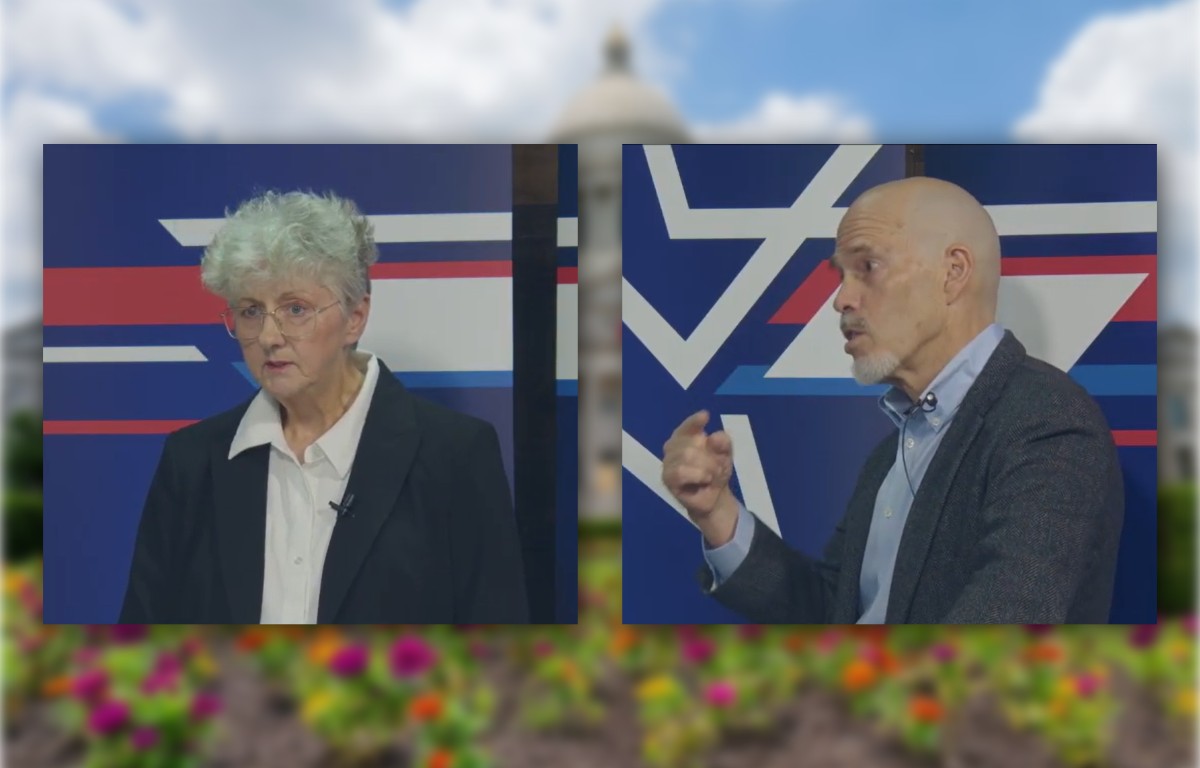

Jonesboro, AR – Jonesboro Right Now – Two challengers vying for the U.S. House of Representatives District 1 seat squared off over the economy, government surveillance, and higher education during a live televised debate Thursday night.
Hosted by ASU-TV, the event featured Democratic candidate Dr. Terri Yarbrough Green and Libertarian candidate Dr. Steve Parsons. Republican incumbent Rep. Rick Crawford did not attend the event, though he is scheduled to participate in an Arkansas TV debate with both challengers next week.
The debate was moderated by Jonathan Reaves and featured a panel of local journalists asking questions: Laganzie Kale of KLEK 102.5 FM, Samantha Mitchell of KASU Public Radio, and Allie Carson of the Herald.
The format afforded each candidate two minutes for opening and closing statements. For each panelist’s question, candidates were given a two-minute response, a one-minute rebuttal, and a one-minute final retort for the candidate who answered first.
While an initial broadcast failure left the live feed with sound issues throughout, causing it to end early, the full broadcast has since been uploaded online.
Opening Statements
During the opening remarks, both candidates leaned on their professional backgrounds to introduce themselves to voters.
Green, a semi-retired pathologist, noted she is “more comfortable behind a microscope than a microphone,” a trait she framed as an asset. She likened her political approach to her medical training: looking for systems that are failing, identifying the root cause, and fixing them.
Green used her time to highlight the ongoing struggles in District 1, pointing to farmers squeezed by forces beyond their control, rural hospitals closing their doors, and families stretched thin by the rising costs of housing, healthcare, groceries, and fuel.
She took a direct swipe at Crawford, noting the incumbent has had 16 years to address these problems while conditions have only worsened.
“My natural inclination is to want to try to fix them,” Green said. “So that’s why I’m here”.
| ADD US ON GOOGLE NEWS: Click here to see more local news from Jonesboro Right Now
Parsons, who holds a Ph.D. in Economics and spent over two decades as a professor, highlighted his roots working in a small family business that operated on incredibly tight margins. He centered his platform around the core principle of “less government and more freedom,” arguing for a reduction in government intrusion into personal decisions, specifically citing seatbelt mandates and marijuana use.
Seeking to distinguish himself from traditional politicians, Parsons emphasized his financial independence from special interests.
“If elected, I will donate my entire salary to local charities, and I have not accepted a dime in campaign donations,” Parsons stated.
Rural Outreach and Regulatory Burdens
KLEK’s Laganzie Kale opened the panel questions by asking Green why the Democratic Party has historically struggled to win over rural voters in Arkansas and the South, and whether the party has lost touch with their values.
Green responded that her focus is on listening directly to rural communities to understand their specific, immediate needs.
She identified basic infrastructure—clean water, functioning sewage systems, and passable roads—as their top priorities, followed closely by job creation. Highlighting a successful example of federal support, she pointed to the town of Luxora, which recently utilized a $10 million grant from the Biden Infrastructure Bill to build a new water tower and pipes.
Parsons, given the opportunity to weigh in, noted the difficulty of running as a third-party candidate in a “super red” district where congressional incumbents enjoy a 97% win rate.
To genuinely support rural economies, he proposed eliminating $181 billion in annual corporate welfare, arguing that these massive federal subsidies overwhelmingly benefit large corporations and put small rural businesses at a severe disadvantage. He also called for a drastic reduction in federal regulations, explaining that while giant corporations can afford teams of specialists to navigate complex rules, small local companies cannot.
During her rebuttal, Green found common ground with Parsons on the issue of regulatory burden. She stated that she “wholeheartedly” agreed with the need to reduce regulations, specifically citing her firsthand experience with regulatory hurdles in the healthcare sector.
Minimum Wage and Economic Policy
The focus shifted to the economy when Kale asked how rural small businesses operating on thin margins would survive a federally mandated minimum wage increase, and whether job losses or business closures were an acceptable tradeoff.
Green stated she would not accept job losses or business closures as a result of a wage hike, suggesting instead that any changes should be implemented gradually and with safeguards in place.
Pointing to broader issues of wealth inequality, she emphasized the need for an economy where workers can earn a living wage, noting that a single salary used to be enough to support an entire family when she was growing up.
Parsons argued strongly against raising the federal minimum wage, asserting that artificial wage floors trigger severe unintended consequences.
Citing historical employment data, he pointed out that after a minimum wage increase in 1957, teenage unemployment—specifically Black teenage unemployment—spiked dramatically. He argued that such mandates can inadvertently allow discriminatory hiring practices to surface.
Instead of raising wages, Parsons proposed combating the cost of living by “neutering the Federal Reserve” to control inflation and halting the practice of paying interest to banks, a policy he labeled a “waste of taxpayer money”.
During the rebuttal period, Green agreed with Parsons that federal laws often carry unintended consequences, suggesting that new economic policies could be tested locally before being mandated nationwide. She added that while the federal government might not explicitly need to raise the minimum wage, it must “level the playing field” to ensure corporations do not have a louder voice than everyday citizens.
This prompted Green to pivot to campaign finance reform, where she advocated for overturning the Citizens United decision and banning stock trading by members of Congress to remove corporate influence from politics. Parsons strongly agreed with the proposed stock trading ban, calling the practice by government officials “repugnant” and specifically criticizing the high volume of trades made by former politicians.
Inflation and Campaign Finance
Green focused her reform arguments on removing corporate influence from politics, advocating for the reversal of the Citizens United decision, even if it requires a constitutional amendment.
“We need to get money out of politics,” Green stated, noting that her own campaign is “not accepting corporate PAC money”.
She emphasized that those with financial power currently hold the ear of elected officials, and she proposed an end to congressional stock trading. To elevate individual voices, she pledged to visit the district and hold town halls, ensuring voters “get an answer that is specific to their question”.
| READ MORE: The latest regarding election races and issues in Craighead County
Parsons strongly agreed with Green regarding congressional stock trading, calling the practice by existing government officials “just repugnant”. He criticized the volume of stock trades made by President Donald Trump, and while acknowledging that the First Amendment protects political action committees, he expressed concern over the financial influence of foreign-aligned PACs, specifically referencing the American Israel Public Affairs Committee (AIPAC).
On the topic of the economy and inflation, Parsons pointed to the expanded money supply as the primary culprit.
He proposed a policy to “neuter the Federal Reserve,” arguing they hold “the greatest long-term influence on inflation” due to their control over the money supply. Additionally, he called for an end to paying interest to banks—a practice that began during the 2008 financial crisis—labeling it “just a waste of taxpayer money”.
Privacy and Government Surveillance
The topic then shifted to civil liberties when KASU’s Samantha Mitchell asked how to balance public safety tools, such as Flock cameras, with individual privacy.
She pressed the candidates on when surveillance tracking—such as monitoring travel to churches or medical facilities—becomes an infringement on freedom, and who should have the authority to make that determination.
Parsons, who answered first, acknowledged the role of public safety but expressed deep skepticism about current legal frameworks, noting that while some surveillance tools are deemed legal, those interpretations do not always match his own views on constitutional privacy rights. To combat potential overreach, he proposed shifting the authority over surveillance from the federal government down to local municipalities.
“I want government to be at the lowest geographic level possible,” Parsons argued, stating that the federal government tends to “become bureaucratic, go crazy, [and be] exceptionally expensive”. He contended that it is far easier to establish rules, protect privacy rights, and allow citizens to sue over the “improper usage” of their data at the state and local levels.
| READ MORE: The Flock Divide: Why Jonesboro is Expanding its Camera Network While Others Pull Back
Green agreed that the issue is concerning, declaring that an individual’s right to privacy should be “paramount”. However, rather than deferring to local governments, she advocated for sweeping federal regulations to reign in modern tracking. She specifically highlighted the government’s growing use of artificial intelligence and facial recognition technologies.
“The invasion of our privacy, how much data they have on us, is quite frightening when you really look into it,” Green said. Pointing to the potential for abuse, she added, “I do not trust that the people that have that information are going to use it wisely. I think we need much more regulation in place… to protect the individuals’ right to privacy”.
Higher Education and Student Debt
The Herald’s Allie Carson shifted the conversation to local demographics and higher education, asking the candidates how they would balance the needs of Northeast Arkansas’s rural communities with a growing university population, and what role the federal government should play in supporting the university’s economic growth.
Green argued against separating the two groups, stating that they function together as interconnected parts of a broader economic system. She suggested that improving rural infrastructure and job opportunities naturally benefits the university and vice versa.
Pivoting to the government’s role in education, Green sharply criticized the current student loan system, contrasting today’s financial landscape with her own college experience. When she was a student, she noted, loans remained interest-free until graduation and employment. Today, she argued, 17-year-olds are signing up for compound-interest loans that can burden them well into retirement.
“I think the federal government, their role is to help people get an education and to provide some low-interest or no-interest student loans instead of the privatized loans that students have at their disposal these days,” Green stated. She also condemned recent administrative cuts to basic scientific research grants, warning that defunding essential research causes a “brain drain” of American talent.
Parsons, noting that he and his wife both have extensive backgrounds working in academia, countered that the American public has been sold a “bill of goods” regarding the absolute necessity of a traditional four-year liberal arts degree. He criticized federal programs that blindly entice students into taking on massive debt without a guaranteed return on their investment.
To fix the system, Parsons proposed that higher education institutions need more financial accountability.
“If [students] default, I would like to see the university have some skin in the game so that they have to repay part of that loan,” Parsons argued. He explained that holding universities financially liable would incentivize them to steer students toward “more productive” degrees and technical certifications that ensure graduates can actually earn a living.
The ASU-TV next debate will be at 6 p.m., Thursday, Oct. 22. for the U.S. Senate race between Republican incumbent Tom Cotton, Democratic candidate Hallie Shoffner, and Libertarian candidate Jeff Wadlin. ASU-TV confirmed that Cotton will not be participating in the debate.
You can re-watch the District 1 debate below and watch the future debates by going to ASU-TV’s YouTube channel.
| DAILY BRIEF: Sign up for the Jonesboro Right Now Daily Brief Newsletter