


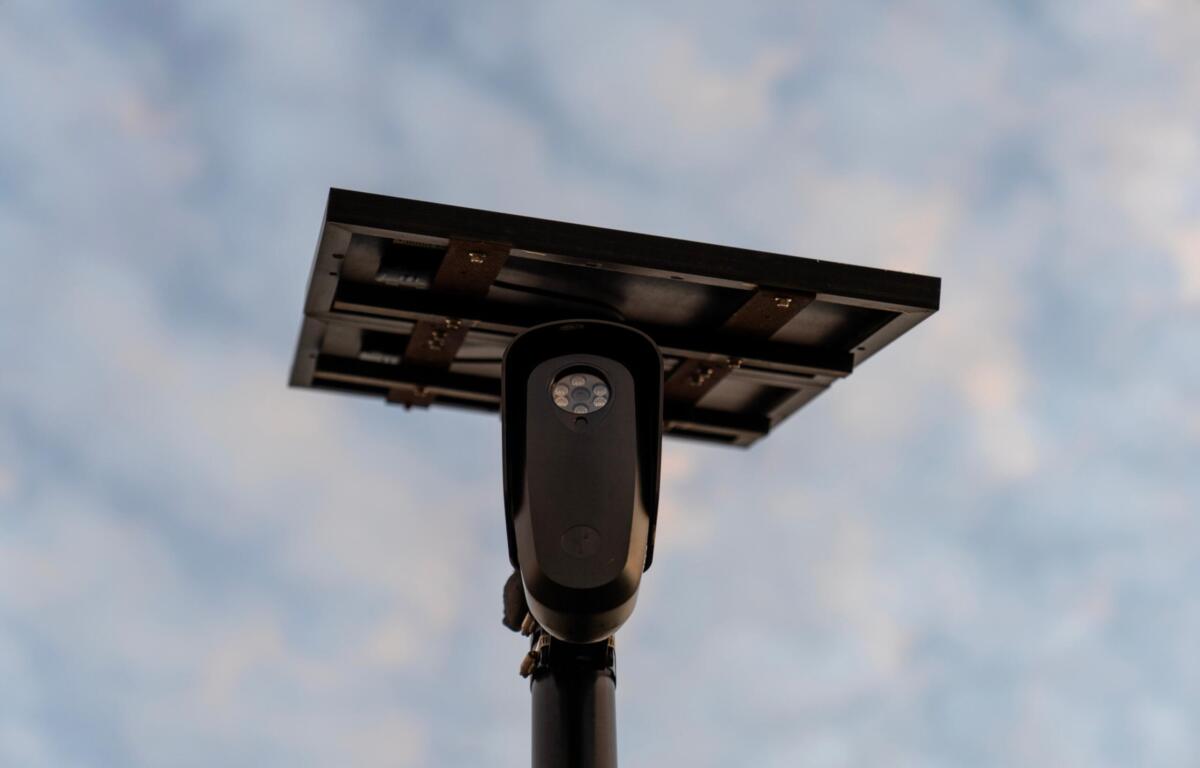

Jonesboro, AR – Jonesboro Right Now – As the controversies surrounding Flock cameras arise and the company is attempting to address public concerns, the Jonesboro Police Department (JPD) is ensuring these devices will help keep the community safer.
Across Arkansas, a growing number of cities are hitting the brakes on Flock cameras and automated license plate surveillance in general.
Several cities have either chosen to suspend their usage of the devices or end it entirely amid privacy and public trust concerns. Those include:
However, in Jonesboro, that is not the case.
| ADD US ON GOOGLE NEWS: Click here to see more local news from Jonesboro Right Now
With 55 Flock cameras active across the city and integrated into the Real Time Crime Center (RTCC), JPD insists they are essential to keeping the community safe.
JRN sat down with Police Chief Rick Elliott and Lt. David McDaniel, who oversees the RTCC, to learn more about the department’s stance and policies on the cameras.
The Operational & Policy Reality
At a cost of roughly $3,500 per camera annually, the Flock network represents a nearly $192,500 yearly investment for Jonesboro.
When asked how the department measures the return on that taxpayer investment, Elliott pointed directly to the unique criminal footprint of the city.
Because Jonesboro draws crowds from a 100-mile radius for medical care, shopping, and dining, it also attracts potential suspects from out of town.
According to Elliott, a mapping analysis conducted two years ago revealed that approximately 28% of all individuals arrested each year in Jonesboro do not live within the city limits. Suspects were said to have traveled from Pulaski County, West Memphis, Memphis, Mississippi, and the Missouri Bootheel to sell drugs, shoplift, or both.
“I can never get enough boots on the ground to do what needs to be done in the world of policing,” Elliott said. “I have to depend on technology to help keep the people of Jonesboro safe.”
The Local Friction
For JPD, the cameras are necessary to keep up with incidents that happen in the city. However, as the network expands, questions about who has access to that surveillance data have recently surfaced right in Jonesboro’s own backyard.
At a Craighead County Quorum Court meeting on Aug. 24, Judge Marvin Day asked Craighead County Sheriff-elect Jason Allen for an update in regard to Flock, to which Allen told the court that the sheriff’s office no longer has direct access to JPD’s Flock camera network.
Elliott told JRN that when the city first adopted the technology, it allowed deputies and Arkansas State Police troopers to log directly into the system. McDaniel noted this initial approach was viewed as a collaborative effort to catch suspects operating within the same city and county jurisdictions.
However, as national reports surfaced regarding law enforcement officers misusing automated license plate readers in other states, JPD leadership realized something needed to change.
“We felt that this is pertinent to just keep control of our information under us, and so I pulled their privileges to access the system,” Elliott explained.
JRN was given a copy of JPD’s internal policy regarding public safety video systems. It explicitly states that personnel are prohibited from using the video security system for anything other than official purposes, and unauthorized use can result in disciplinary action including termination.
Because outside agencies do not answer to JPD’s internal disciplinary structure, allowing them unrestricted access to the Jonesboro network created a liability, Elliott said.
Despite the loss of direct login privileges, the sheriff’s office is not completely locked out of the technology. Elliott said that if the county decides to purchase its own Flock cameras, it can regain access to the shared network – but the burden will be on the county to implement its own oversight.
“It’s incumbent on them to develop their policy, procedures, and mechanisms in place,” Elliott said.
Until then, county investigators working active cases can still rely on JPD’s network through the RTCC.
“I’ve got it staffed, and [if] something goes on in their world that they need us to run a tag for investigative purposes, all they have to do is contact us,” Elliott said. “For them, it’s just a phone call away.”
The Investigative Aspect: A Spoon vs. a Fork
To understand JPD’s stance on the Flock system, it is important to look inside the RTCC itself.
The center acts as the technological nerve center for the city, monitoring over 700 camera feeds, including 15 SkyCops and dozens of traffic cameras.
According to McDaniel, there is a distinct difference between those traditional video feeds and the Flock license plate readers. He equated it to a simple analogy.
“If I invite you over to eat soup at my house, you hope I give you a spoon and not a fork,” McDaniel said.
In this case, the Flock cameras are the fork.
Unlike SkyCops or the traffic cameras, the Flock cameras do not continuously record video. Instead, they use artificial intelligence (AI) and optical character recognition (OCR) to capture still snapshots of license plates and specific characteristics of a vehicle like a dented bumper or roof rack.
McDaniel said the system does not show driver identities, registration details, or insurance status. Rather, it simply flags the plate numbers against the National Crime Information Center’s (NCIC) hotlist for stolen vehicles or active warrants.
JPD pointed to various high-profile successes as proof of the system’s necessity, including an incident on Aug. 23, when a driver was the victim of a hit-and-run in a Walmart parking lot.
McDaniel explained that by using a video clip provided by staff, JPD identified specific stickers and prior damage on the fleeing suspect’s vehicle. They ran those characteristics through the Flock system and identified the suspect in less than 24 hours.
“I think in the past… I don’t think we ever would have solved that crime,” McDaniel said regarding the hit-and-run. “Now we know the registered owner of the vehicle… it’s truly a game changer for just catching bad guys.”
It is for those types of investigations that Elliott said the department would not adopt Flock Safety’s new default corporate recommendation to delete captured plate data after seven days.
While Flock argues that 90% of successful searches occur within the first week, JPD currently holds unflagged plate data for 30 days, which is Flock’s previous recommended time frame for deletion. And they intend to keep it that way.
Elliott and McDaniel explained that investigations led by the Second Judicial District Drug Task Force often require detectives to review weeks of a suspect’s travel patterns across state lines to build a robust case.
“That investigation would last longer than seven days,” McDaniel noted. “So, it needs to stick that information… you want to be able to watch that particular dealer for more than seven days.”
If the data is not flagged for a specific criminal investigation or traffic accident, it is automatically purged from the servers after 30 days due to storage costs.
Accountability & Combating Misuse
As the technological capabilities of the RTCC expand, so do the national concerns regarding how license plate databases are managed and guarded against misuse.
Recent headlines out of several states, including Missouri, have highlighted instances of law enforcement officers using Flock systems for personal reasons, such as stalking ex-partners or running unauthorized searches on neighbors.
When asked about this, Elliott and McDaniel acknowledge the controversies but maintained that their internal safeguards prevent such abuses from happening in Jonesboro.
According to JPD’s official policy manual, unauthorized viewing, reproduction, or dissemination of surveillance data for non-official purposes is strictly prohibited and carries penalties “up to and including termination”.
To enforce this, McDaniel explained that every search requires unique login credentials and a documented reason or case number. The system also employs AI to automatically audit officer behavior, directly flagging any unusual searches to the command staff.
“I get alerts on that kind of stuff like, ‘Hey, we think this is outside the norm, you might want to look into it,'” McDaniel said.
He noted that while these flags usually result from officers misunderstanding how to properly build a hotlist – such as searching the same plate every 20 minutes instead of automating an alert – the audit trail guarantees that if an officer were using the system to keep tabs on a personal acquaintance, the department has the tools to catch and discipline them immediately.
The department’s policy also safeguards against automated errors, such as a camera misreading a plate from another state for an Arkansas plate with the same characters.
Before initiating a traffic stop based on a Flock alert, JPD policy mandates that an officer must visually verify that both the alphanumeric characters and the state of issuance match the system’s alert. McDaniel said that a Flock hit does not automatically grant probable cause; it simply draws the officer’s attention to a vehicle so they can establish lawful grounds for a stop.
Despite these protocols, the debate surrounding automated license plate readers is far from settled.
Elliott anticipates that the tension between civil liberties and public safety technology will be a topic during the next Arkansas legislative session in Little Rock. He added that he is prepared to make JPD’s case directly.
“I know there’s some legislators that… may not be a proponent for this,” Elliott said. “Their challenge is you bring the people in here that were affected by Flock. Find those people and bring them to these committee meetings. On the flip side, I can fill the place up with people that were saved by Flock or had a positive outcome of Flock. So, the positive things outweigh what you think you may be infringed upon.”
For McDaniel, the privacy concerns aimed at law enforcement often feel misplaced when compared to the vast amounts of data Americans willingly surrender daily.
“Let’s talk about the cell phone in your pocket and what your credit card company knows about you,” McDaniel said. “I guarantee your credit card company knows more about you than your own mom does, and they sell your information… Why is that not the topic?”
For residents curious about how the technology tracks vehicles nationally, transparency advocates recently launched HaveIBeenFlocked.com, a database built from public audit logs that allows drivers to check if their license plate has been queried in the system by participating agencies.
| DAILY BRIEF: Sign up for the Jonesboro Right Now Daily Brief Newsletter