


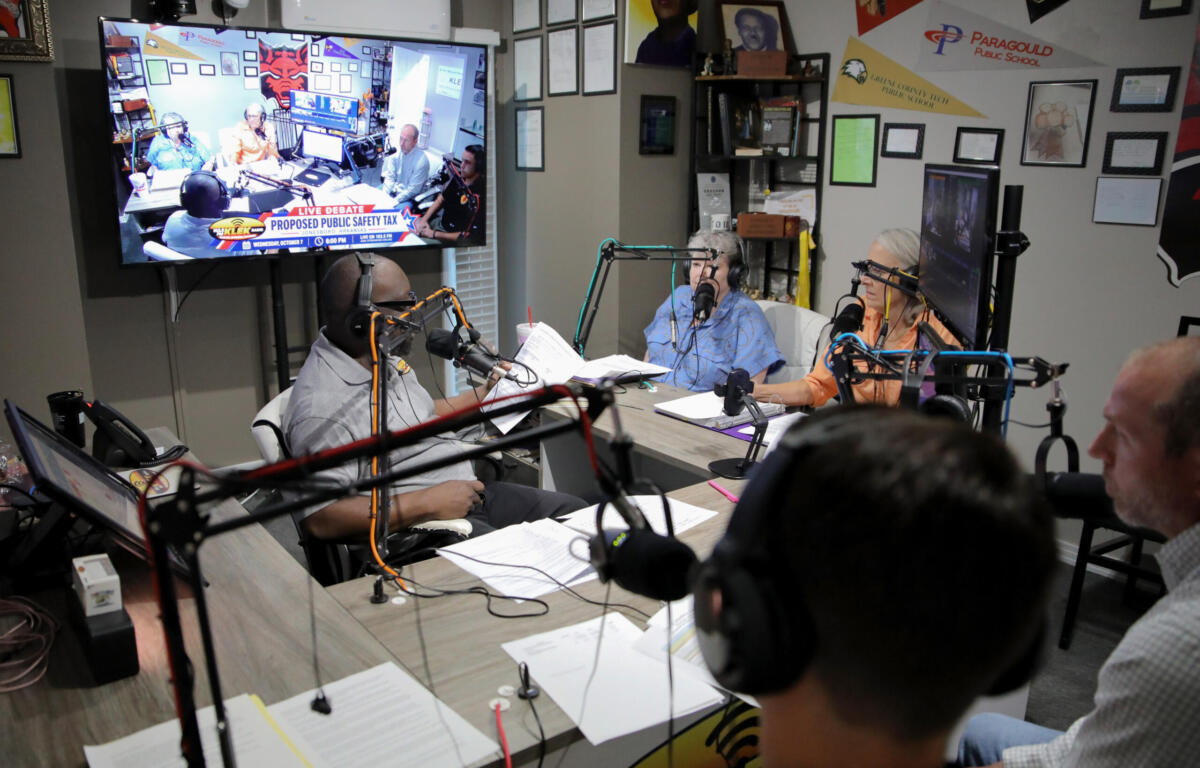

Jonesboro, AR – Jonesboro Right Now – Representatives from both sides of the proposed public safety sales tax ballot issue debated Wednesday night.
The debate, hosted by KLEK 102.5 FM, brought together Ethan Ivy and Scott Byrd from Safety First for Jonesboro, which petitioned throughout the summer to place the issue on the ballot, and Iris Stevens and Robin Martin from Citizens Taxed Enough, which opposes the tax.
The debate was sectioned into three segments: in the first part, KLEK general manger and debate moderator LaGanzie Kale asked questions to each group, of which they had two minutes to respond. The opposing side had a one minute response, followed by a final one minute rebuttal from the other side.
| ADD US ON GOOGLE NEWS: Click here to see more local news from Jonesboro Right Now
In the second segment, Kale read questions from viewers watching the debate’s livestream, and in the final segment, each organization was allowed to ask questions of the other. Safety First for Jonesboro spoke first during opening statements, and Citizens Taxed Enough spoke first during closing statements.
The proposed 5/8 cent sales tax, if approved, will be used to fund “public safety services, initiatives, facilities, infrastructure, maintenance and operations.”
Safety First for Jonesboro leadership have previously said the tax revenue would be dedicated exclusively to Jonesboro’s police, fire and E-911 dispatch services. The money would help fund construction of a new police station, new fire stations and the hiring of additional police officers, firefighters and dispatchers.
Opening Statements
During Safety First’s opening statements, Ivy said the tax increase came down to a “simple math problem.”
“We’re the second biggest city in the state geographically. We’re the fifth biggest by population, but we don’t break the top 10 when it comes to revenue collected, and that has led to an increasing gap between the level of public safety that the citizens of the city deserve and need and the level of public safety that we’re able to provide,” he said.
When a previous sales tax, which would have funded public safety and parks improvements, failed to pass seven years ago, Ivy said organizers examined concerns raised by residents and Citizens Taxed Enough and addressed them, such as narrowing the tax’s focus to public safety only, putting the issue before voters in a general election, and making the tax a permanent one.
“Our question is, what more does your organization expect from us to support what first responders have stated we need to protect the citizens here in this city?” Ivy said.
During the opening statements for Citizens Taxed Enough, Stevens said in light of that previous tax failing, Jonesboro residents have known that the city’s public safety services required more funding. She contended that the city had not properly prioritized funding, focusing on wants instead of needs, specifically pointing out parks and public transportation.
“These projects, considered quality of life projects, aren’t bad. They add to city living. However, the real quality of life lies with well-funded, well-functioning police and fire departments,” Stevens said.
“It appears that our city leadership may have failed in its duty to fund fully our safety departments adequately, but the city does have a lot of money that should be used to fund your departments without the financial damage such a tax would do to the over 40% of Jonesboro residents either living in poverty or hovering just above it,” she added.
Moderator Questions
Kale asked the Safety First representatives what safeguards would be in place to ensure the tax adds to, and does not replace, the city’s existing budgets for police, fire and dispatch.
Ivy responded that while the city’s overall funding during budget cycles had increased over the years for public safety, that money was still not enough to address the needs of those departments, which included the construction of new fire stations and hiring more staff. He added that independent employees and organizations will work to hold leaders accountable and ensure the money is directed toward public safety initiatives.
Kale then turned the discussion toward Citizens Taxed Enough, asking what their practical alternative would be to fund police, fire and dispatch needs if the tax fails.
Martin said the city’s reserves could be allocated to help fund these projects. She also pointed to a plan presented to the Jonesboro city council in early December 2025 that laid out strategies for the long-term growth of the Jonesboro Fire Department (JFD). That plan lays out ways to acquire funding for department growth, such as pursuing grants, considering a dedicated sales tax, and more.
| READ MORE: Jonesboro Fire Department reveals long-term growth strategy
Ivy responded that grants were not permanent, and that the departments could not hire staff through grants, and that spending out of the city’s reserves was “not sustainable.” Martin responded that grants could be used to fund equipment needs.
Kale then asked Safety First for Jonesboro representatives why a sales tax was the fairest way to fund public safety needs, as such a tax would affect shoppers of all income levels.
Ivy said organizers looked into other ways to fund needs outlined in the long-term growth plan, but said solutions presented, such as a fire fee for Arkansas State University students or implementing hotel occupancy fees, were not viable due to the city not having power over A-State, and the Arkansas Attorney General saying utilizing occupancy fees to fund these needs could not be done.
“We have many people that come into our city to shop for business, for various reasons, and these people use our services. They use our parks, our streets, they use our fire department, they use our police department,” Ivy said. “A sales tax is the only way to offset roughly half of those costs to those visitors. Any other form of revenue generation – property tax, things like that – put the entire burden of the cost on the residents of our city.”
Stevens responded by pointing to the amount of people in Jonesboro living in poverty or close to it. Over 22% of Jonesboro residents live below the poverty line, she said, combined with another approximately 20% “working poor.”
“These are people that sales taxes hit the worst,” she said.
Kale asked included asking Citizens Taxed Enough what level of accountability they would need to support a similar tax increase in the future. Martin responded that while the city’s overall sales tax might be lower compared to other similar sized cities, county sales tax needed to also be taken into account.
| READ MORE: Click here for the latest stories regarding issues and candidates on the ballot
Residents in similar sized cities with comparable county sales tax rates, such as Springdale or Rogers, have much higher median incomes – up to $30,000 higher – than Jonesboro, Martin said.
“They’ve got a lot more money running through their economy, a lot more money that they can pay sales taxes with,” she said.
Ivy responded that if the tax passed, the city’s sales tax will still remain low, and Jonesboro will remain affordable.
Kale then asked Safety First for Jonesboro what evidence shows existing city budgets do not currently meet department needs.
Ivy responded that other previously mentioned solutions, such as grants, hotel occupancy fees, and more, were either not feasible or would not generate the money needed to fund the city’s public safety needs. These needs required a constant, steady revenue stream.
Martin responded that Citizens Taxed Enough had looked had the tax’s ballot language, and had some concerns about the wording.
The ballot language includes language saying it will fund police, fire and dispatch needs, but Martin raised concerns over other projects the ballot says the tax would fund, such as animal services and code enforcement buildings, safe rooms and street lighting, cameras and monitoring equipment, and related administrative offices. Jonesboro’s Animal Services and Code Enforcement departments fall under the Jonesboro Police Department. The full ballot language can be read here.
“This is much broader than we anticipated that it would be,” Martin said. “Could related administrative offices include all of City Hall? It’s all part of the same government. Could hundreds of Flock cameras be purchased and maintained with this funding?”
| READ MORE: The Flock Divide: Why Jonesboro is Expanding its Camera Network While Others Pull Back
Other questions asked included asking what Citizens Taxed Enough’s primary concern was regarding the tax, and asking both sides a concern the other had they believed was legitimate.
Questions from Live Feed
One viewer asked if Safety First representatives could detail the complete plan for how the tax was to be used if approved.
Ivy explained that full ordinance and ballot issue can be viewed online, and said the study regarding JFD’s long term growth came from an outside firm, and that public safety needs had been documented for years before this issue came before voters. Both Stevens and Martin contended that the city council had ultimate authority over where money was to be spent.
“Until they come up with a plan, we don’t know what the plan is,” Martin said.
Another viewer asked why Jonesboro’s mayor and top administration officials were not addressing the public safety funding issue. Stevens and Martin called upon city administration to find solutions to fund city needs without adding more taxes.
| READ MORE: Jonesboro City Council Approves Police Officer Recruitment Incentives
Ivy responded that city officials have spoken in favor of the issue, and cited endorsements from former Jonesboro mayors, but said the organization did not want the issue to get bogged down into “politics as usual.”
Other questions asked by viewers included asking why Citizens Taxed Enough did not think the city’s operating budget was not being used wisely, and, if the tax failed, if Citizens Taxed Enough would work with city officials to determine an alternative plan for funding.
Questions Asked by Each Organization
Ivy asked Citizens Taxed Enough what their counterproposal would be to generate the $50 million to $100 million needed to fund the public safety needs without placing that full burden on Jonesboro citizens.
Martin responded by returning to point she previously discussed, such as applying for grants and using the city’s reserve funds. She also said meeting with their organization before considering placing it on the ballot, to see what concessions could be made to get their support, would help.
Citizens Taxed Enough then asked Safety First for Jonesboro approximately how much more money they would need per year to fund their needs, provided they still receive their full budgets from the city. Ivy responded it would take roughly $16 million to $17 million per year.
Closing Statements
Citizens Taxed Enough said their issues included it ballot language, which they said is broader than the scope of police, fire and 911 services, and there was zero guarantee that these departments could see increased funding, as public safety departments could see decreases in their overall budgets from the city.
They said the issue would place a greater financial burden, especially on lower income people, and that there were other ways to fund the departments’ needs. The long-term growth study presented also left out Craighead County sales tax in addition to the city’s existing sales tax.
“We ask that everybody vote against this Safety First tax and tell city leaders to prioritize first responders with their current tax revenues,” Martin said.
| READ MORE: Town Hall in Jonesboro Discusses Public Safety Tax, Office Consolidation Ballot Issues
During Safety First’s closing statements, Byrd said the costs to effectively fund public safety departments had increased, as had the staffing needs of these agencies. Ivy added that these funding figures were public and encouraged voters to research the issue themselves.
“We’re trying to do more with less, but if we’re going to meet the needs of this city – 82 square miles, subdivisions popping up all over the place eight minutes away from fire stations – we’ve got to address these needs, and the only way to do it is with more revenue. And this is the only plan in place to address those needs,” Ivy said.
Early voting for the 2026 general election begins Oct. 19 and will conclude Nov. 2. Election Day will be Tuesday, Nov. 3. Click here for a sample ballot.
The full debate, broadcasted on KLEK 102.5 FM, can be viewed below.
| DAILY BRIEF: Sign up for the Jonesboro Right Now Daily Brief Newsletter