


Jonesboro, AR – JonesboroRightNow.com – Since its founding almost two years ago, the Jonesboro Police Department’s Crisis Intervention Team (CIT) has continued to make an impact.
According to statistics released by JPD, the CIT responded to over 2,500 calls in 2024 and 2025, and over 600 people interacted with the CIT/Therapist team.
Additionally, the program has saved a total of $1.2 million. Of that total, around $432,000 was saved by avoiding jail diversions, while around $787,000 was saved by avoiding medical diversions.
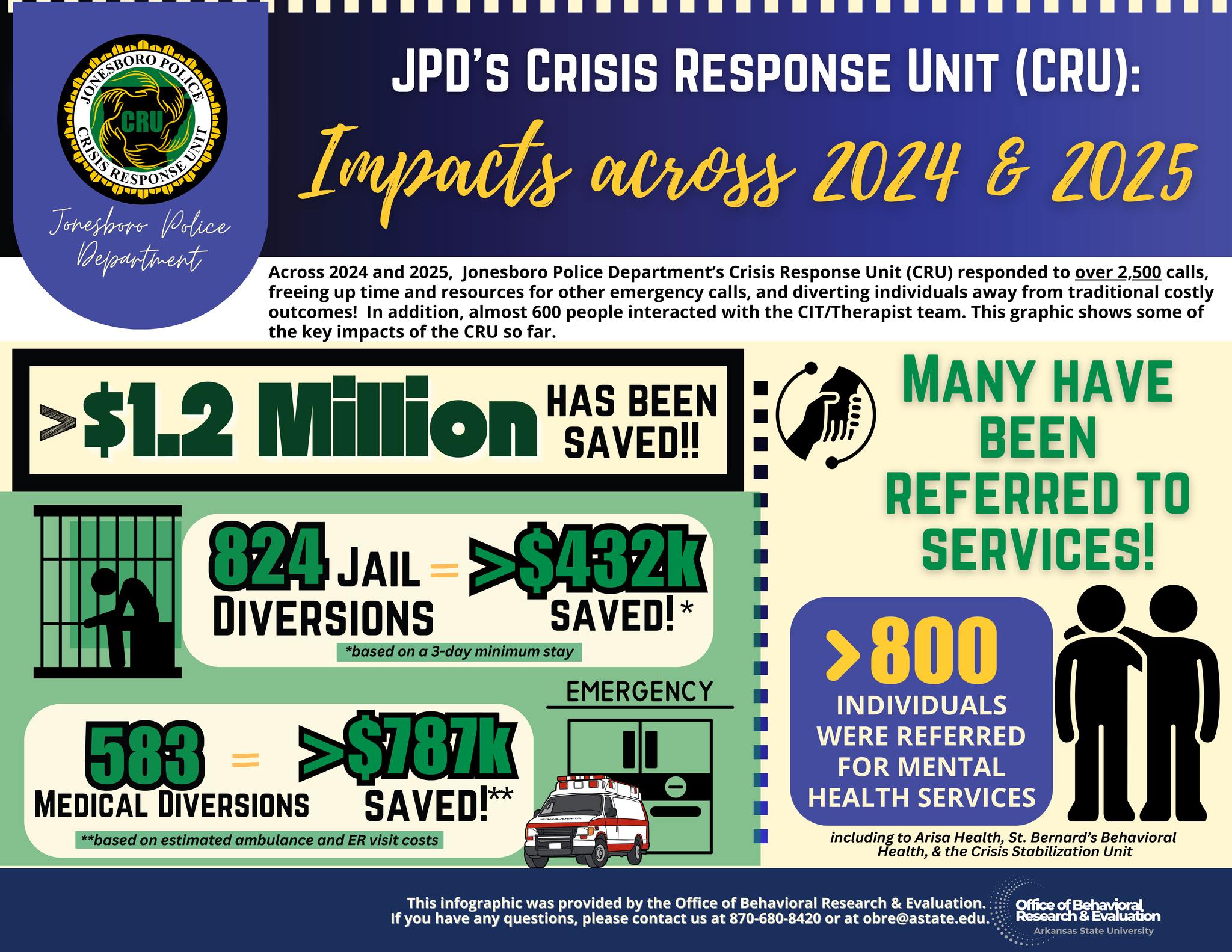
Sherry Adams, CIT coordinator, said the $1.2 million figure was a combination of the money saved by avoiding sending someone to jail and the cost of avoiding ambulance rides to emergency rooms.
“How that’s accomplished is what would have actually been somebody going to jail, but instead they were taken to some type of facility or getting some type of assistance. We base that off of what would normally cost to be in the jail and go through all that process,” Adams said.
She continued: “As far as the number of referrals that’s given as far as in the field, like officers referring people to mental health facilities for outpatient treatment. Officers referring people to different resources because everything is not always a crisis about mental health. It could be a crisis about ‘I don’t have food; I don’t have diapers for my kids today.'”
| READ MORE: Jonesboro crime numbers down as population increases
Adams added that while all crisis calls are initially treated as mental health calls, once the responding team arrives at the scene, they work to determine how to best help.
The CIT was founded in May 2023. It consists of two CIT officers, as well as a therapist, who work Monday through Thursday. Additionally, all officers on JPD’s force receive CIT training.
“Having the therapist on scene, she can address and assess if this person is needing something else,” Adams said. “That’s one of our main goals, is jail diversion, because you don’t want someone that has a mental illness to be treated as if they did some type of criminal act.”
Since the program’s creation, Adams said it has not only saved the city money, it has also saved money for those individuals who are being helped by CIT. Since CIT officers can transport people in a mental health crisis to an emergency room, they can avoid the high costs of an ambulance ride, she said.
“What officers were doing and how that was probably leading to other things, which was leading to jail time, which was leading to a court case,” she said. “This person has a mental illness, so they’re probably not going to come back to court. So, that causes [Failure to Appear]. It was just a cycle, so I would say that taking them out of that cycle, at this particular time, has saved a lot of money.”
Additionally, the program saves non-CIT officers time and allows them to respond to more calls. Adams explained that CIT calls are often lengthy, so by having the CIT team respond, other officers can go to calls that are “a bit more pressing” or require extra manpower.
Adams stressed that the CIT was there to help the community.
“We’re there to help. We’re not there to hurt in any type of way,” she said. “That’s what we’re here for, to try to get you the help that you need.”