



Jonesboro, AR – JonesboroRightNow.com – For low-income mothers across Northeast Arkansas, hitting “Day 61” after childbirth means navigating a health insurance hurdle as they navigate the physical and emotional toll of recovery.
Arkansas is the only state in the nation that terminates postpartum Medicaid 60 days after delivery. The status was cemented last month when Wisconsin lawmakers voted to extend its postpartum Medicaid coverage to a full 12 months, according to the Associated Press.
Medicaid funds 50 to 60 percent of all Arkansas pregnancies annually. State law mandates that low-income women receive coverage during pregnancy and for 60 days postpartum. After that, they must either transition to employer-sponsored plans or the federal health exchange.
Maternal health advocates have contended that this transition is rarely seamless.
Camille Richoux, health policy director for Arkansas Advocates for Children and Families (AACF), told JRN that 44% of postpartum mothers lost Medicaid coverage in the fourth quarter of 2025, making it the worst retention rate since reporting began. She added that recent data shows approximately 95% of those mothers are not successfully transitioning to the federal Marketplace or other coverage.
The Clinical Reality of Day 61
According to the data, the 60-day cutoff ignores the timeline of maternal recovery. Medical professionals note that some of the most dangerous pregnancy-related complications frequently emerge or peak between three and twelve months after delivery.
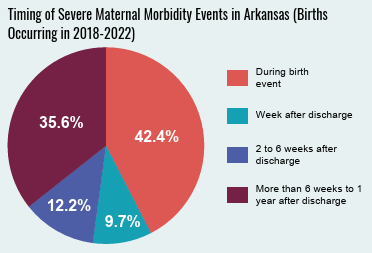
An October 2025 report from the Arkansas Center for Health Improvement (ACHI) noted that 35.6% of severe maternal morbidity events occur between six weeks and one year after a mother’s discharge from the hospital.
Mortality data shows a starker picture. A December 2025 legislative report from the Arkansas Maternal Mortality Review Committee (AMMRC) found that 94% of pregnancy-related deaths in the state were preventable. Furthermore, 34.8% of those pregnancy-related deaths occurred between 43 days and one year postpartum.
Dr. Christopher Bellamy, an OB-GYN at NEA Baptist in Jonesboro, said that pregnancy also frequently uncovers underlying issues like cardiovascular, endocrine, or diabetic disorders that require extensive, long-term management.
State leadership has maintained that extending foundational Medicaid is not the right solution to these issues. Gov. Sarah Huckabee Sanders and some local lawmakers have opposed the 12-month extension, pointing instead to alternative state initiatives like the “Healthy Moms, Healthy Babies Act”.
In a September 2024 article from NPR, Sanders is quoted from a press conference saying, “I don’t believe creating a duplicative program is actually going to fix the issue. We already have so many women who aren’t taking advantage of the coverage that exists. Creating more coverage doesn’t get more women to the doctor.”
According to the Statewide Strategic Maternal Health Plan, the state’s focus is on addressing the crisis through alternative means, such as creating pathways for doulas and community health workers, increasing telehealth usage, and unbundling Medicaid payments to encourage more doctor visits.
While Bellamy acknowledged that these alternative tools are a “big step” toward identifying high-risk patients, he cautioned that they fall short when it comes to actual long-term treatment.
“The next step in terms of close follow-up, management, treatment, if medications are involved, that’s not going to be fixed in your first 60 days,” Bellamy said. “If they lose coverage, then I fear that that’s maybe where you’re going to lose some of those patients.”
Richoux echoed this concern, noting that, while alternative programs strengthen the system, targeted programs cannot substitute for comprehensive coverage.
“When nearly half of postpartum moms are losing Medicaid shortly after birth, they lose access to the very services the state has worked to build,” Richoux said. “Continuous Medicaid coverage for 12 months postpartum is what ensures mothers can actually access the care, prescriptions, mental health treatment, and follow-up services that keep both moms and babies healthy.”
Bellamy also pointed to an often-overlooked consequence of the 60-day cutoff: The sudden loss of contraceptive coverage. He explained that without comprehensive insurance, mothers may not be able to afford the long-term contraceptives necessary to avoid rapid, successive pregnancies during their most fertile and vulnerable physical window.
The Political Debate & Patient Responsibility
For local lawmakers representing Northeast Arkansas, the balance between expanding a foundational health program and relying on these new initiatives remains a point of debate.
State Sen. Dan Sullivan, R-Jonesboro, acknowledged that Arkansas standing alone is an issue that will likely be debated, but cautioned that a legislative fix won’t happen immediately.
“I think we can’t do that right now. We’re in a fiscal session,” Sullivan said. “I fully expect that to happen in the 2027 legislative session”.
State Rep. Dwight Tosh, R-Jonesboro, agreed that 2027 is the realistic timeline, noting the difficulty of passing non-budget legislation during a fiscal session. However, Tosh pointed out that the House passed a bill to extend postpartum Medicaid to 12 months in 2025, but it died in a Senate committee. Tosh said he supports expansion and expects it to be a priority again in 2027.
State Rep. Jack Ladyman, R-Jonesboro, who sits on the House Public Health Committee, said he voted for the extension both times it ran, but noted the primary hurdle is finding the funding to pay for it.
“Yes, I believe the 12-month coverage would help us,” Ladyman said.
Sullivan also contended that the state needs time to evaluate the effectiveness of the new maternal health programs introduced in 2025 before expanding coverage. He pushed back against the narrative that Arkansas is falling behind by maintaining the 60-day limit.
“To say that Arkansas is an outlier here in this area, without looking at what Arkansas [does] in a positive way, is a spin,” Sullivan said.
While lawmakers debated the policy, Sullivan maintained that navigating the insurance transition after 60 days does not fall solely on the government.
“Ultimately, it’s the patient’s responsibility to seek support and help,” Sullivan said.
Ladyman agreed that individuals need to make the best decisions for themselves, but he added that they still need support no matter what.
“That don’t mean we just kick them out after day 60, and we don’t help them with that decision,” Ladyman said.
The Rural Roadblock
In Northeast Arkansas, the loss of Medicaid coverage at 60 days is compounded by a geographic barrier. Lawmakers across the board acknowledge that the state’s maternal and infant mortality crisis is heavily concentrated in rural areas.
“Access is hard. We’re in rural states,” Sullivan said. “One of the solutions would be to mandate doctors to live in rural Arkansas. They’re not going to do it”.
For Bellamy, expecting rural mothers to navigate an uninsured gap while also facing massive physical hurdles is a recipe for disaster. Bellamy noted that many of his patients face an hour to an hour-and-a-half drive just to reach his clinic.
“You’ve got the long drive is one thing. You’ve got the lack of coverage is another thing,” Bellamy said. “If you take one of those away, maybe that helps improve that ability for them to say, ‘Okay, yeah, I can go do that.'”
Ladyman pointed to expanding telemedicine to help rural mothers bridge this gap. However, Bellamy warned that telehealth can only do so much.
While virtual visits are excellent for identifying postpartum anxiety and depression, Bellamy noted that diagnosing many life-threatening physical complications requires a physical exam and for those patients to be seen in person.
Tosh emphasized that even with alternative maternal health programs and remote monitoring, if rural mothers lack transportation or access to a doctor, the state’s efforts are failing.
“If we do all this and they still don’t have a way to go see their doctor, to me, we’ve come up short,” Tosh said.
The Transition Hurdle
Richoux added that expecting a woman with a two-month-old child to seamlessly navigate the federal exchange is unrealistic.
“In practice, that transition happens during one of the most physically and emotionally demanding periods of their lives, often while they are recovering from childbirth, managing complications, and caring for a newborn,” Richoux said. “Expecting new mothers to shoulder this administrative burden at six weeks postpartum is a dangerous approach with real consequences.”
In a joint statement, Kaitlyn Gardner, Licensed Professional Counselor (LPC), and Kristan Williams, LPC, with The Quiet Grove, an Arkansas-based counseling practice focusing on perinatal mental health, noted that the abrupt end of coverage can lead to postpartum fatigue, anxiety, and depression, leaving mothers without access to crucial psychiatric treatment or therapy.
“When insurance coverage ends at 60 days, mothers may delay or forgo care due to cost concerns,” the counselors said. “This gap in coverage can leave mothers without the support they need at a time when mental health interventions are most effective, with consequences for both mother and child.”
The state’s own Maternal Mortality Review Committee recommends that health systems ensure case managers are present in clinics for high-risk patients to give necessary care coordination and follow-up. However, achieving that follow-up becomes increasingly difficult when the patient loses their ability to pay for the visit just weeks after giving birth.
With the legislative debate over postpartum on pause, the daily reality for expectant mothers in Northeast Arkansas remains unchanged.
When asked about the clinical stakes of waiting another year to address the coverage gap, Bellamy was blunt.
“There’s gonna be big gaps in coverage, and you know, hopefully it doesn’t show up as a big maternal mortality issue, delaying it by a year,” Bellamy said. “But it definitely has the potential to have significant impact.”