



Jonesboro, AR – (JonesboroRightNow.com) – It has been six months since the City of Jonesboro passed a measure to improve downtown traffic. But some businesses say pedestrian safety is still not being addressed efficiently.
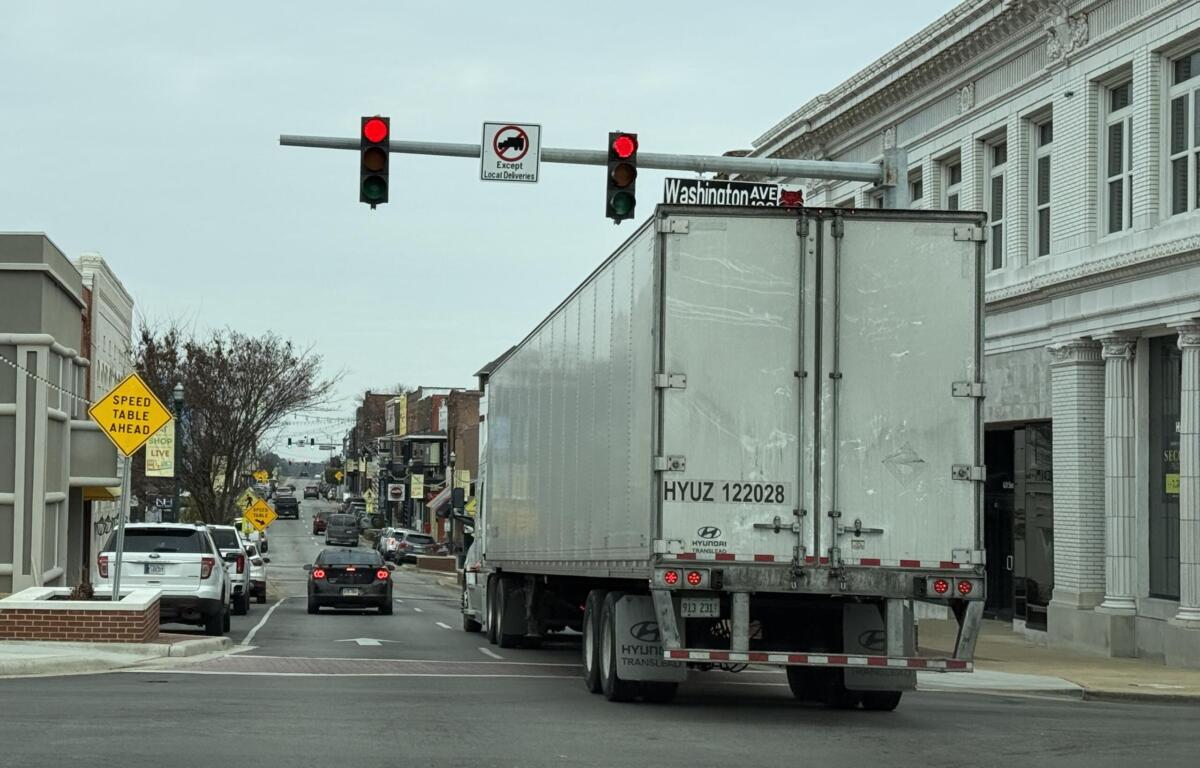
On June 17, the Jonesboro City Council passed an ordinance that would designate an alternate truck route for downtown Jonesboro. According to the ordinance, the reason for the route is that streets like Main, Union, and Church have limited road width and high pedestrian activity, making them unfavorable for commercial trucks.
The ordinance says commercial trucks would only be permitted on these streets between Highland Drive and Johnson Avenue for local deliveries. To ensure that drivers are able to navigate safely, signage was added to downtown, indicating that trucks are only allowed if they are making local deliveries.
Jonesboro Police Chief Rick Elliott said initially, they did not have a lot of signs indicating the change, but since the ordinance was set in motion, new signs have been added, starting at Southwest Drive. Due to a lack of signs, officers gave more written warnings than tickets. However, he said drivers should get the picture by now.
“We think people have had enough, ample opportunity now to know what’s right, what’s wrong, especially if you have somebody that lives locally and makes regular routes,” Elliott said. “It’s time that they be ticketed.”
Regarding the amount of truck traffic, Jonesboro Mayor Harold Copenhaver said it’s about the same as before, with the timing of the holiday season playing a factor currently. He said some of the most common trucks seen downtown making deliveries include those from Dollar General, UPS, and FedEx.
The ordinance also details a fine structure for commercial trucks entering the area that are not in the process of a local delivery. Fines range from $250 for a first offense to $750 for a fourth offense.
Elliott told JRN that they use an electronic ticketing program, so when a driver is stopped, an officer can look at what’s in the system and see if that driver has been warned or ticketed previously. However, he said his department is currently 18 officers short, making dedicated patrols difficult.
“Our officers are pretty much going from one call to the other,” Elliott said.
“For us just to have a patrol officer sit on Main Street for 12 to 16 hours a day and not continue to patrol the rest of the community, that’s not an effective way to do it,” Copenhaver said, adding that in addition to cameras, they are working with Elliott on how to process possible offending trucks in the area.
Copenhaver told JRN that, while they are not as concerned about the fine, they are more concerned about the trucks not making local deliveries going into downtown. He explained that if they see recurring cases, there will be further procedures in place to deal with the issue.
“I mean, do it once, okay, that’s kind of like everything, but you do it two or three times, then you’re not going to get away with it again,” Copenhaver said.
Downtown Businesses React
Opinions on the truck ordinance have had a mixed reaction from the businesses JRN spoke with. Many of the businesses downtown said the city’s approach to fixing the issue isn’t enough.
Elizabeth Hoke, owner of Generations Floral Company, said it is hard to say if there has been a reduction in the number of trucks that go through downtown. While getting around the trucks isn’t a problem, it’s how other drivers react to the trucks that can lead to issues.
Sarah Boyd, manager of Skinny J’s, said that the biggest part of the issue is the timing of when the trucks come through.
“It’s interfering with the retail hours, a lot of us keep down here for customers. That’s where we find our issues with pedestrians,” Boyd said.
Ted Herget, owner of Gearhead Outfitters, said the trucks don’t bother him, although he mentioned they don’t need them on Main Street because of the wear and tear on the street. However, he feels that more drivers are speeding down the street despite measures to prevent that from happening.
“You get everybody going around downtown, and they’re still treating it like it’s a state highway,” Herget said.
While some businesses were mixed on what they thought of the truck ordinance, they all agreed that pedestrian safety is a priority.
“The ticketing can only go so far, because it’s not going to be the same drivers all the time that are coming through, but if they could understand that the ordinance is being enforced, that may change the way they go around,” Hoke said.
“[The city] won’t do anything if somebody gets killed, you know, and that’s their MO. I mean, they’re reactive, not proactive,” Herget said. “I don’t think we change anything downtown, except just put one lane right down the center, and people will get through there just like the lunch line, slow and steady.”
When talking to JRN, Copenhaver mentioned that there might be a plan of action for Main Street involving “a different routing, so to speak, or design of Main Street accessibility,” with one lane being dedicated to delivery.
Copenhaver emphasized that to make these changes work, communication is going to be key.
“If downtown individuals are there all the time and they see a recurring company truck, they can help us too by communicating, then we can provide the resources in a more timely and efficient manner,” Copenhaver said.
Communication Breakdown
JRN contacted several freight companies in the area for comment. However, despite multiple attempts to connect, those companies did not respond as of press time. However, the Arkansas Trucking Association was able to comment.
Shannon Newton, president of the Arkansas Trucking Association, told JRN that there is often a meaningful lag between when a city adopts or changes a truck route ordinance and when that information appears in navigation systems used by drivers.
“These updates depend on cities proactively sharing accurate data with mapping providers, which does not always happen quickly or consistently,” Newton said. “As a result, drivers can find themselves with no way out, particularly in unfamiliar areas.”
In regard to being notified about the Jonesboro ordinance, Newton said JRN’s email request sent Dec. 17 was her first time learning of its existence. She added that she reached out to three of the association’s members in Jonesboro, and all referenced learning of the ordinance from either JRN or Newton.
“The association did not receive direct communication from the city regarding this change, and based on the little research I’ve done this afternoon, the industry was largely left to discover it on its own,” Newton said. She added she could not confirm any engagement or education with the trucking community regarding prior issues, the need for the change, or expectations for compliance.
When JRN asked the city, Donna Malone, communications director for Jonesboro, said the city went through the process of changing street patterns and informing residents specifically through traditional and online media. She added that the Arkansas Department of Transportation (ARDOT) was also contacted about the ordinance.
Dave Parker, public information officer for ARDOT, told JRN that the request they received from the city was to install warning signs for the trucks before entering downtown. He clarified that the restriction only applies to city roads, not the highways.