


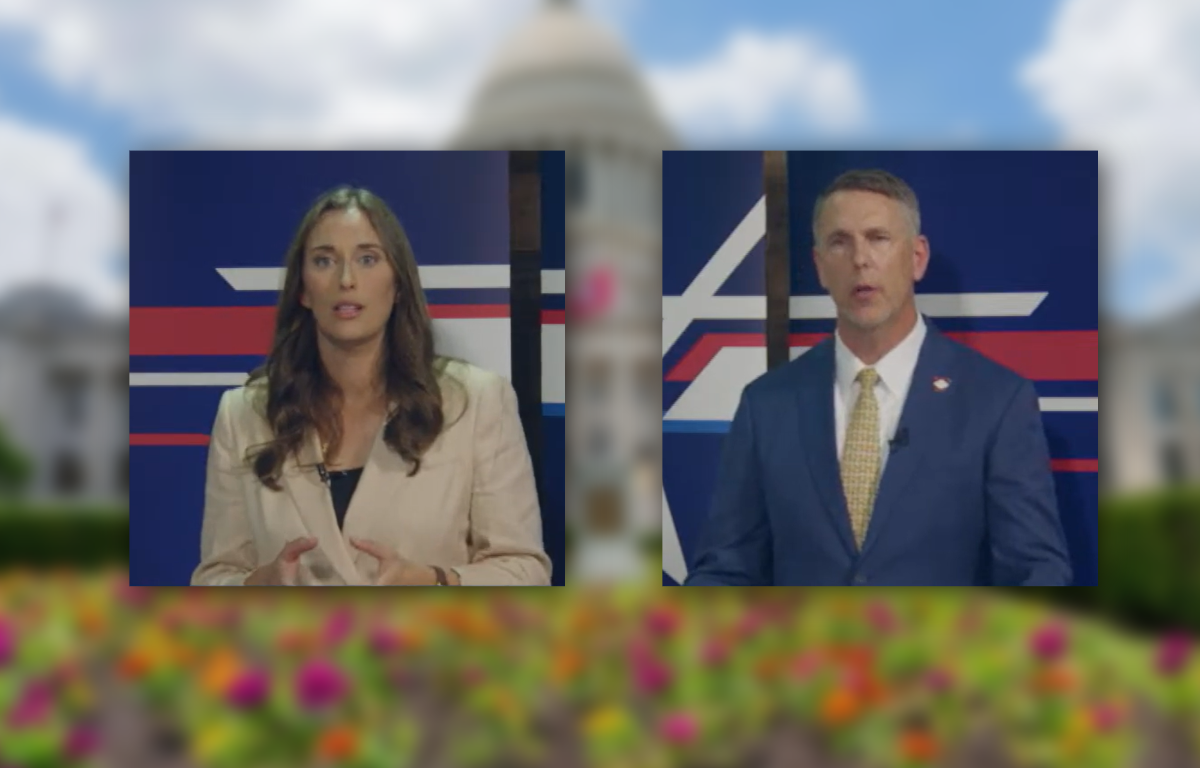

Jonesboro, AR – Jonesboro Right Now – Healthcare, agriculture, and workforce support were among the topics discussed during the student-run debate between two candidates vying for the U.S. Senate seat for Arkansas.
Hosted by ASU-TV, the student television network of Arkansas State University, the debate saw Democratic candidate Hallie Shoffner and Libertarian candidate Jeff Wadlin take questions from four panelists for roughly an hour. Republican incumbent Sen. Tom Cotton was invited but did not respond to the television station’s invitation.
| READ BEFORE YOU VOTE: JRN’s Guide to the 2026 Craighead County Ballot
Candidates had two minutes for opening statements, of which Shoffner went first, followed by two questions from four panelists representing professional and student-run media outlets and organizations. Candidates had two minutes to respond to a question, with their opponent given two minutes to rebut, followed by a final one-minute response. Wadlin spoke first during closing statements, of which candidates had two minutes.
KASU program director Marty Scarbrough moderated the debate. Panelists for Thursday’s debate included A-State instructor of mass communications Johnathan Reaves, KASU reporter Lexie Burns, Herald editor-in-chief Allie Carson, and A-State Pre-Law Club president Levi Seward.
Use the following links to jump to a specific topic.
| ADD US ON GOOGLE NEWS: Click here to see more local news from Jonesboro Right Now
Opening Statements
During her opening statements, Shoffner spoke to her experience as a sixth-generation farmer and Cotton’s absence from the debate and voting record, such as his support for the war in Iran and support of the One Big Beautiful Bill Act.
“I’m here because last year I had to close my family’s 150-year-old farm because of farm prices. I have lived with the rising costs, I have lived the broken system, and I decided I wouldn’t surrender,” she said.
In his opening statements, Wadlin spoke to his career as an engineer and businessman, which he said gives him experience solving complex problems. He said his goals included reducing inflation and decreasing debt, as well as withdrawing from foreign wars. Like Shoffner, he also pointed to Cotton’s absence.
“Like a lot of you, I’m unhappy with the direction the country is headed right now. But I was also unhappy four years ago when the other team was in charge,” he said. “That’s why I’m in this race: to give you a third option.”
Government Shutdown and Earning Reelection
Reaves asked the first round of questions, in which he asked the candidates how they would prevent a government shutdown, pointing to the 43-day shutdown earlier this year that occurred after legislators reached an impasse regarding approving governmental funding. He also asked if candidates would take a salary if they were in office when a shutdown occurred.
Shoffner responded that she would not take a salary if a shutdown happened. She said during her time on the campaign trail, she spoke with people on all sides of the political aisle, and said they often agreed on several topics. Politicians in office were more extreme than the average person, hence political stalemates.
Wadlin responded that shutdowns were the result of Democrats and Republicans being unable to work together, which he said was causing a slew of issues, including healthcare being in “shambles” and the exhaustion of Social Security funds. He added that politicians should not be paid if the government is shut down.
Reaves then asked candidates, if they were elected, what accomplishments would be used to measure if they should be reelected.
Wadlin responded he would push for a balanced budget and work to reduce national debt, as well as overhauling Social Security to not only ensure funding for seniors, but make it more lucrative for young, working adults.
Shoffner responded that she would push for improvements in rural healthcare, as well as strengthening Social Security, Medicare, and Medicaid, as well as bolstering public education and support for farmers.
Maternal Healthcare, Food Insecurity, and Agricultural Support
Panelist Burns pointed to Arkansas’ high maternal mortality rate, as well the state being the only in the country to still offer 60 days of Medicaid postpartum coverage compared to the rest of the country’s 12 months. She asked the candidates if they supported expanding postpartum coverage to 12 months, and how they would Arkansas’ maternal healthcare overall.
| READ MORE: The 60-day cliff: Inside the debate over Arkansas’s postpartum Medicaid limit
Wadlin responded that he did support expanding Medicaid support to 12 months. He responded that nationwide, healthcare was far too expensive and that in order to improve health overall and ensure more people are covered, costs needed to be reduced by half. Labor and delivery services also needed to be offered closer to more people, he said.
“That’s certainly possible because we pay twice as much for prescription drugs in this country as other first world countries, we pay twice as much for hospital service, and we pay seven times as much for administrative services,” he said.
Wadlin later said a supply-side solution was needed to improve healthcare costs, in which prices are regulated by healthcare company, similar to how power companies structure their costs.
Shoffner responded that she also supported increasing postpartum support to 12 months. To improve maternal healthcare, everyone needed access to affordable insurance, she said, but rural healthcare needed to be strengthened as well. To bolster rural healthcare, that also means investing in roads and other infrastructure, business development, and increasing wages, she said.
Burns then spoke to expiration of the 2018 Farm Bill, which legislators have tried and failed to pass a new version of. She pointed to how disputes over SNAP funding (Supplemental Nutrition Assistance Program) drove the new Farm Bill’s repeated defeats in the legislature, and asked candidates how they would comprise between agricultural support and nutrition funding.
Shoffner responded that a new Farm Bill was needed and proposed a “Food Bill” solution that involved incentivizing farmers to diversity their crops to include fruits, vegetables, and grains, and then be able to sell that produce back to their communities. This also supported smaller, farm-related businesses as well, she said, that wash, store, and flash-freeze crops.
“It is healthier, it is fresher, it is more affordable, because on average, it takes 1,500 miles to get a vegetable on your plate in Arkansas,” Shoffner said. “Diesel at $6 a gallon, that’s a lot of money, that’s a lot of cost that’s being passed on to Arkansas families.”
Wadlin responded that the issue was another example of the “endless gridlock” between Republicans and Democrats, but that a new Farm Bill was needed. He said high tariffs and foreign wars, which were driving up costs for commodities such as fuel and fertilizer, were further contributing to the problem.
He responded that a removing subsidy programs and allowing farmers to “follow the money” and produce crops that are “actually profitable,” was the solution.
Supporting the Next Generation of Farmers and Workers
Carson, the next panelist, asked the candidates the specific steps they would take support the next generation of farmers as many prepare to enter the workforce, and prevent trade policies that further harm farmers.
Shoffner echoed previous statements, saying tariffs and foreign wars were hurting farmers, and pointing again to her “Food Bill” proposal. She also spoke to farmland consolidation, saying that as farmers went out of business, high network individuals and corporations were buying up the land. This resulted in land being owned by a few people and organizations.
“We have to make sure that we pass legislation that will keep land in Arkansas in the hands of our active farmers,” she said.
She later said investments needed to be made in schools and public infrastructure, adding that she would like to set up a technical assistance offices for Arkansas cities and counties that apply for federal grants, to ensure that support system is in place.
| PREVIOUS ELECTION COVERAGE: Click here to read coverage of previous debates and local ballot issues
Wadlin also referred back to previous statements regarding pulling out of foreign wars, high tariffs, and deregulating and ending agricultural subsidizing. He also spoke to supporting “right to repair” legislation, in which farmers are allowed to repair and maintain their equipment, as well as purchase parts and manuals at reasonable prices.
Carson then asked candidates what they would do to support new workers as they face higher costs of living.
Wadlin pointed to the national debt and federal reserve. National spending was further increasing debt and was inflationary.
“That is creating a crisis down the road for young people. That debt is ultimately doing to have to be worn by someone,” he said.
The federal reserve responding to economic crises, such as the 2008 banking crisis or the 2020 COVID crisis, resulted in the printing of more money, further increasing inflation. He said legislation to create stricter monetary policies was needed.
He later proposed amending Social Security to include children’s investment accounts, allowing payroll taxes to be reduced over time, saving young people money annually.
Shoffner responded that ending trade wars and the war with Iran would help, but also that the economic growth of cities like Jonesboro needed to be supported. She added that more affordable housing within the communities that employees work in was needed.
“I’ve met too many young people who work in the city but have to drive 30 minutes to an hour in because they cannot afford to live there,” Shoffner said. “That means they’re just shoving their paycheck into their gas tank.”
Foreign Lobbying and Cotton’s Absence
Seward, the final panelist, asked the candidates if domestic lobbying groups heavily involved in a foreign state’s policy goals, such as American Israel Public Affairs Committee (AIPAC), should be required to register under the Foreign Agents Registration Act (FARA), and why or why not.
AIPAC is a political lobbying group that advocates for a strong relationship between the United States and Israel. FARA is legislation enacted in 1938 that requires certain agents of foreign principals engaging in political activites to make periodic public disclosures of their relationship with that foreign principal.
Wadlin responded that these groups should have to register with FARA, and that the country needed to distance itself from the influence of super PACs. He said he would work to repeal Citizens United v. FEC, a Supreme Court decision made in 2010 that ruled certain electioneering communications paid for by corporations, labor unions, and other organizations violated the First Amendment’s free speech clause.
“Citizens United needs to be relitigated, and the reason for that is the way campaign contributions work, you can’t donate $1 million to my campaign. The limit is $3,500, because that’s a quid pro quo,” he said. “That quid pro quo still exists, even for super PACs. When AIPAC wants attack ads against Tom Cotton’s opponents, he knows where that money comes from, and he certainly owes them a favor, and he certainly is repaying those favors daily.”
Shoffner responded that she agreed with Wadlin’s points, and that she supported enshrining anti-corruption laws and campaign finance reform in the U.S. Constitution. She also spoke in support of term limits and ethics laws for justices and Supreme Court justices.
Seward then pointed to Cotton’s absence and asked what decision or vote of his that the candidates would ask him to defend if he was present.
Shoffner responded that she felt she could not pick one decision, speaking on his support of the war with Iran and the One Big Beautiful Bill Act. Wadlin responded that he disagreed with Cotton’s support of the Iran war and foreign wars in general.
Closing Statements
Wadlin spoke first during closing statements, telling viewers that they had a choice between two parties that had increased national debt and failed in healthcare reform and agricultural support.
“In this race, you have a choice between the Republican, who is a problem maker; the Democrat, who is a problem finder, or me, who is a problem solver,” Wadlin said.
Shoffner said along her time on the campaign trail, the people she’d spoken with had hope for the future.
“Tom Cotton is going to come back to Arkansas because it’s election season and no other reason, and he’s going to ask us to choose a side. Well, let’s choose a side. I’m going to choose you,” she said. “I choose the people of Arkansas every single day, and that is why I’m asking you to choose me as your next United States senator.”
Early voting for the 2026 general election began Oct. 19 and concludes Nov. 2. Election Day will be Tuesday, Nov. 3. Click here for a sample ballot. In addition, GOJO, the public transportation system of the City of Jonesboro, is providing free rides to early vote, click here for more information.
The full debate can be viewed below.
| DAILY BRIEF: Sign up for the Jonesboro Right Now Daily Brief Newsletter