


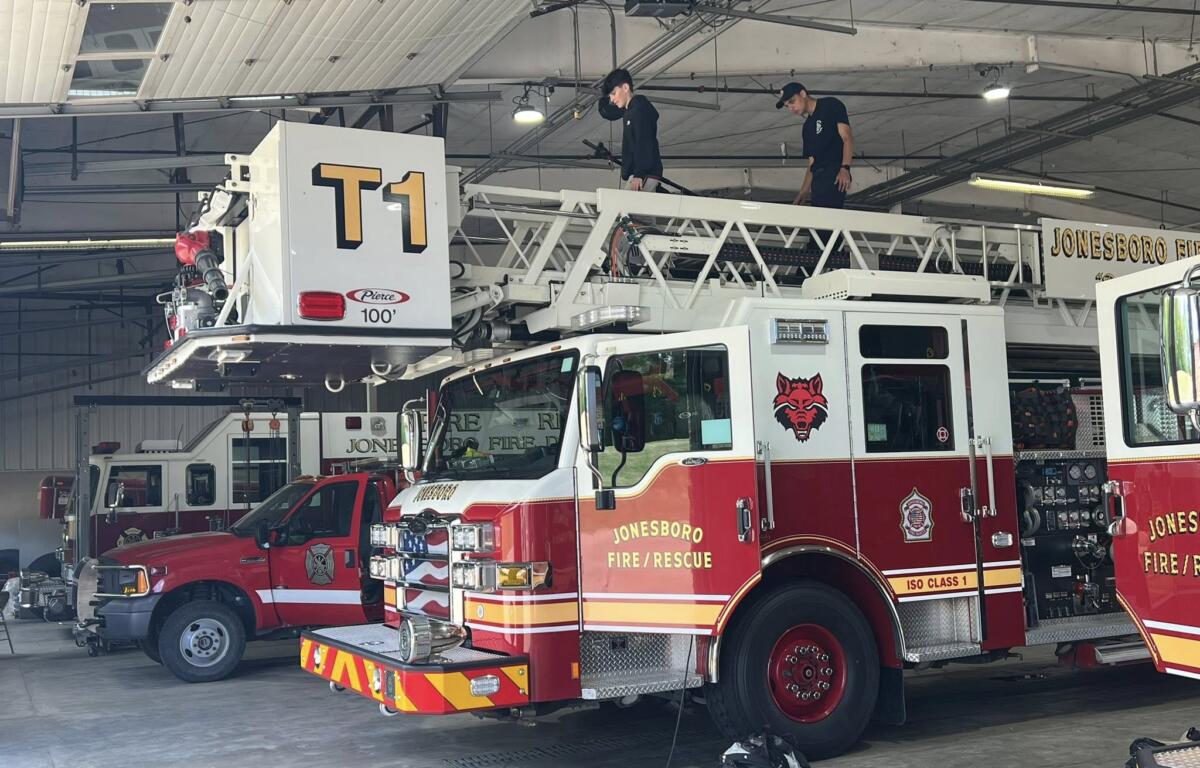

Jonesboro, AR – (JonesboroRightNow.com) – The results of a study to recommend long-term growth plans for the Jonesboro Fire Department were presented during Tuesday’s city council meeting.
The study provides possible plans for the short-, mid-, and long-term growth of the department. Emergency Services Consulting International conducted the study, and the results were presented by the project’s director, Michael Hogan.
JFD Chief Marty Hamrick told JRN the study contains recommendations for improving the department both internally and externally.
“These recommendations serve as a ‘road map’ of national standards and best practices to move the JFD forward over the next 10-15 years,” he said.
Short-Term Changes:
For the short-term changes, which would occur over the next one to three years, Hogan said the study recommended the hiring of a second assistant chief to help divide responsibilities between administration and operations, as well as improving executive oversight.
Increasing minimum daily staffing from the current 29 personnel to 33 was also recommended, resulting in hiring an additional 15 firefighters overall.
“With this, it would allow the ladder trucks’ minimum staffing to go from two to three, and it would allow the minimum staffing on Engine 7 to be increased from three to four,” Hogan said.
According to Hogan, Engine 7 was selected for additional staffing because of its location, on the outskirts of town, which requires more time for backup to arrive. Per OSHA regulations, he said, four firefighters would need to man Engine 7, so two could respond while two stayed with the engine.
Other short-term recommendations are:
- Purchasing land for new training grounds
- Training firefighters for supervisory roles, such as company officer or chief ranks
- Installing a system in each fire station to capture exhaust fumes from fire engines
- Establishing a peer support hotline and stipend
- Holding regular medical evaluations that comply with the National Fire Protection Association (NFPA) standards
- Increasing engagement with a wellness coordinator
- Improving radio interoperability
Mid-Term Changes:
For the midterm, which the study defined as the next three to seven years, another increase in staffing was recommended. This would increase minimum daily staffing from the proposed 33 firefighters to 36, which Hogan said would result in the implementation of four-person crews on the department’s ladder trucks.
In addition to increased staffing, Hogan said the study recommended hiring another full-time person to the training department, as well as a data analyst role and a public information officer.
In the mid-term, Hogan added there may be a need for an eighth fire station. According to the report, a central portion of Jonesboro experiences a high call volume but “lacks sufficient response coverage within recommended time benchmarks.” The report defined time benchmarks as a four-minute response for the initial arrival of emergency services.
“The location of Fire Station 8 should be centered within this underserved region to optimize travel times and reduce the burden on existing units, especially those already experiencing high call volumes and concurrency issues,” the report read.
Hogan added that a location for Station 8 would need to be determined in the future, if plans moved forward for its construction.
Other mid-term recommendations are:
- Equipping ladder trucks with advanced life support
- Exploring the possibility of a fire-department-based EMS transport to supplement the current, private EMS services
- Continued workforce development
Long-Term Changes:
In the long-term, defined as the next seven to 15 years, the study recommended the creation of a city emergency manager role. Hogan said there is already one at the county level, as well as one at Arkansas State University.
Hogan explained it’s important “as the city starts to experience the uptick in more natural hazards, to be able to have a dedicated emergency manager for that spot.”
As the department expands, Hogan said there would be a need to hire a logistics manager and chief of staff, as well as staffing each fire unit with four personnel. He added that, depending on the city and population growth, there may be a need for a ninth fire station or more units at current stations.
Also proposed was a “community paramedicine program,” which would have EMS personnel deliver in-home care and follow-up visits to those with chronic health conditions, who were recently discharged from the hospital, or who frequently use emergency services.
“This approach helps stabilize patients before their conditions escalate into emergencies, ultimately reducing unnecessary 911 calls, emergency transports, and emergency department visits,” the report said.
To fund these changes, the study proposed a hotel occupancy fee, which Hogan said could be as low as $1 to $2 per night. The study also suggested adding a fee to the tuition of A-State students and applying for grants.
“The taxpayers are already paying for the fire service there, but the people that are visiting from out of town, it allows them to pay and contribute to have that high level of services,” Hogan said of the hotel fee. He added that the A-State fee followed the same idea.
In the near future, Hamrick told JRN the department would work to enhance the mental health and wellness of its personnel, work with the New York Institute of Technology at A-State to provide comprehensive medical evaluations, improve communications with private EMS providers, establish a safety committee, and enhance internal communications and information sharing.
Read the full study here.