


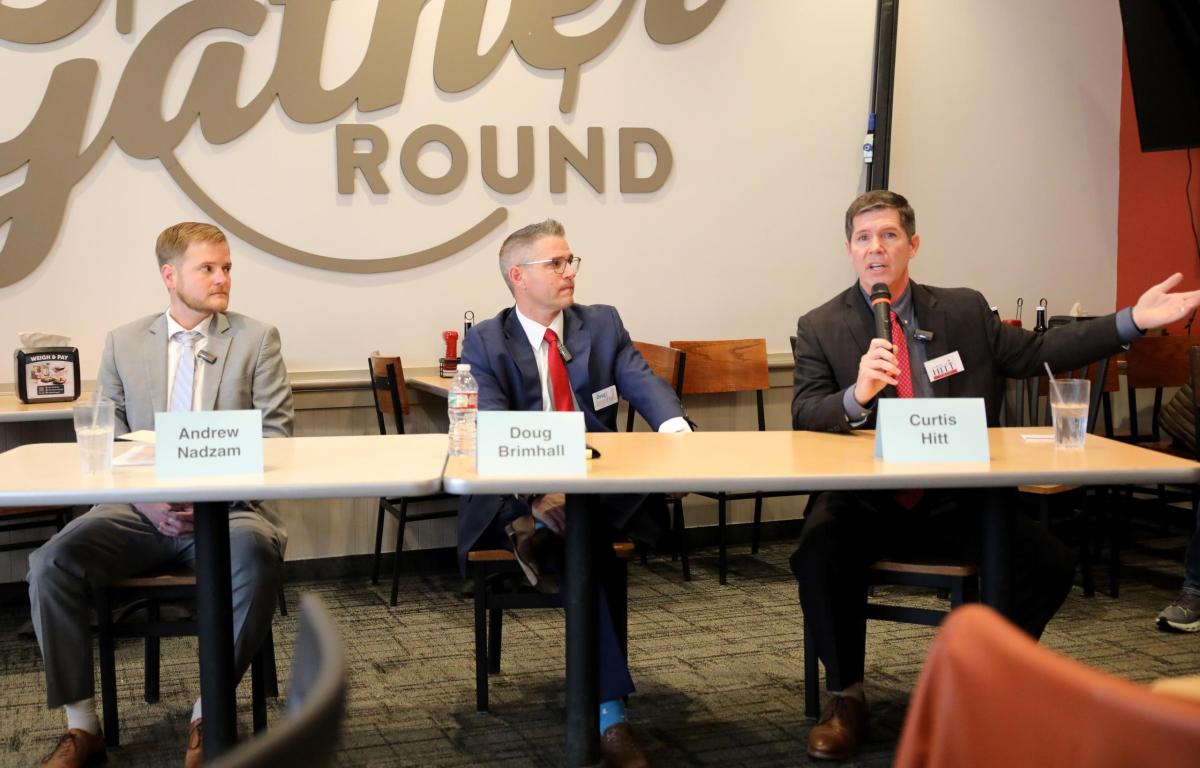

Jonesboro, AR – (JonesboroRightNow.com) – The Jonesboro Kiwanis Club hosted a debate on Wednesday between the three candidates running in the race for circuit judge in Division 4 of the Second Judicial District.
The candidates for the nonpartisan position are incumbent Circuit Judge Doug Brimhall, Greene County District Judge Curtis Hitt, and Deputy Prosecutor Andrew Nadzam. The Second Judicial District represents Craighead, Clay, Crittenden, Greene, Mississippi, and Poinsett counties.
The debate was moderated by assistant professor of multimedia journalism at Arkansas State University, Dr. Ron Sitton. All questions were either asked by Sitton or Kiwanis Club members.
Early voting for the election begins Feb. 17 and concludes March 2. Election Day is March 3. Click here for more information about the election. While this election acts as the preferential primary for partisan candidates, it is the general election for nonpartisan judicial candidates.
A transcript of the debate, edited for clarity and conciseness, is below. The full debate was livestreamed by KLEK 102.5 FM and can be watched below.
Before the debate began, each candidate drew to determine the speaking order. Nadzam was to speak first, followed by Brimhall and finally Hitt. From there, each candidate alternated who went first to answer questions. Candidates had two minutes to speak.
Opening Statements
NADZAM: I’m Andrew Nadzam, and I am running for circuit judge. I am married to Jessica Enderlin Nadzam, and we have two young boys.
I spent my whole adult career performing public service in Northeast Arkansas, first as a private practice attorney and later as a public defender, and now as a deputy prosecuting attorney.
I am running on my record of experience, integrity, and public service. But I’m also running to restore public trust to the judiciary, especially Division 4. It is clear, based on my conversations with voters, that the public has lost public trust with Division 4, based on the incumbent’s actions and decisions. We deserve circuit judges who lead with strong leadership, ethics, and integrity. I believe we deserve a circuit judge who is a servant leader with experience and integrity. I believe I’m the best candidate for this position.
BRIMHALL: I’m Circuit Judge Douglas Brimhall. I recognize many of you in here. Many of you have seen me grow up since I was a little kid. Some of you I haven’t met yet, or I’ve met along the way, but I am thankful that Kiwanis has had me come today to speak to you, as the incumbent judge.
I’m born and raised in Jonesboro, Arkansas. In fact, not only a block from here, where the McDonald’s is, my grandmother built the first house on Stadium. My family is from here. I’m married to Brittany, we’ve been married over seven and a half years. She is a wonderful wife. We have four daughters. We are a blended family. We don’t use the term ‘stepchild’ in our house. All children in our household are my daughters.
I had a law practice for 14 years, I worked for DHS [Department of Human Services] representing parents that had their children taken away. I was a part-time prosecutor.
And yes, Mr. Nadzam brought up an issue that happened in May of ’24, a very touching issue. But I task him to find any role or anything I’ve done since taking the bench, because I’ve done nothing but serve with integrity and honesty and fair decisions. I take everything that comes before me, right, wrong, or indifferent, I apply it to the law, and I’ll make my decision. And I stand behind my decision. I ask for your vote.
HITT: My name is Curtis Hitt, and I appreciate the opportunity to visit with you today about my candidacy for the office of circuit judge. I’m currently serving my appointment of Gov. Sanders as the district court judge for the 17th Judicial District, which is Greene and Clay counties. Up until that point, I was in my 29th year of law practice.
I’m married to my wife, Shauna, we’ve been married for going on 27 years. We have two children.
During my tenure as an attorney, I practiced first as a deputy prosecutor, I did that for seven and half years, and that’s why I went to law school. I handled thousands of cases, I prosecuted half a dozen homicide cases, lots of child molesters, helped with law enforcement secure a number of life sentences against those offenders. Then, I went to private practice, and I had Hitt Law Firm, small business owner for 20 years.
I hold myself out as a candidate in good faith, qualified by experience, not just yours, but by the experiences that I’ve had representing clients and prosecuting on behalf of our community. And I too, am asking for your support.
QUESTION: What in your background indicates the fairness encouraged to do as you must when upholding the law, regardless of your personal conviction?
BRIMHALL: Being a circuit judge for the past year, prior to taking the bench, I was told that being a circuit judge is one of the loneliest positions you could ever have. A very thankless job, and a very scrutinized job. Sitting on the bench and making decisions. You have to negate, shut out everything, your beliefs, and take what is presented to you to the law.
As an attorney, when you would try a case, you’d put your time, your efforts, and you would just spend countless hours. Whether you lost the case or won the case, there was always that thing in the back of your head: ‘What could I have done better? What did up, miss?’ Since taking the bench Jan. 1 of 2025, I’ve not laid down one night and questioned a decision I’ve made. I’ve not lost sleep over it. I’ve sat there and felt that every decision I made is well-founded in the law, and it was the right decision.
So, while some people, and there might be an assumption that judges may make rulings based on personal agendas or their bias, when people come before me in court, they know they’re getting a fair hearing, they’re being heard, and that the judge is making the right decision.
HITT: Having practiced for the better part of 30 years, appeared in front of innumerable judges, and I’ve appeared from both sides of the courtroom. And I’ve appeared in front of probably upwards of 16 juries. Those juries are comprised of individual members of our community. And you always go into those kinds of forums, knowing that you can’t make everybody happy, you can’t please everyone. So, you have to, very quickly, learn what your own convictions are, and you also have to know who you are and where you stand.
And you have to have a good conscience, and you do have to lie down at night, hope to sleep. And so, all you can really be is yourself.
And I’ve only been on the bench for a couple of weeks, but it’s been a fast and furious baptism by fire. You know, I had numerous people come in front of me, and you have to have the kind of temperament that can adjust from one person to the next. And although you don’t have the pressure of satisfying clients or meeting their concerns, you do have the pressure of getting it right.
You want to be fair and honest to your convictions while even-handedly applying the law. And I found that that comes naturally to me, and I’m encouraged by that.
NADZAM: I think step one, in honoring the rule of the law, is following the law. And over the course of my career, my life, I’ve tried, to the best of my ability, to do that. I think, both as a defense attorney, and then as a deputy prosecutor, I’ve seen both sides, and I’ve seen cases, and won jury trials as a defense attorney, and as a deputy prosecutor, while following the law.
And so, over the course of my career, and I think, frankly, that’s a large reason why my colleagues voted me President of the Craighead County Bar Association. They respect my temperament, my levelheadedness, my intelligence.
And so, through my personal action, how I lived my life, how I treat my family, I have followed the law, and I don’t believe personal beliefs, or whether I believe a law is written correctly or not, that’s the legislature’s prerogative and area of concern.
And whether I disagree with the law, the judge is bound to apply the law and the facts and to reach a decision, and if you’re doing that as a judge or as a prosecutor, sometimes you’re probably gonna reach a conclusion that you don’t agree with. But you don’t want to evade the province of the legislature and put your personal feelings, and so you got to make the tough call and say, ‘Hey, I don’t like this result, but at the end of the day, I’m bound by the separation of powers and just follow the legislature in the letter of the law.’
QUESTION: It is my opinion that judicial positions, despite having to be nonpartisan, have become more partisan. Do you agree or disagree with that, and how do you deal with that?
HITT: As a factual matter, I think that you can look at the situation and see that partisan politics do play a role. I think that judicial races should be nonpartisan. I think the prosecutor races should be nonpartisan. I thought that before prosecutor races became nonpartisan, and I expressed as much.
I think it should be nonpartisan, because I mean, we’re duty-bound, follow the law, to honor the Constitution, and to apply the law even-handedly. But I do recognize that politics invariably enter the equation.
Ideally, a candidate’s personal politics won’t enter the equation. And I think we have to be committed to that. But if we’re all being real, we recognize that our worldview does inform the way we see the law. And so, I mean, I think it’s fair for people to express their opinions as may be related to politics, and to this end, I’m a strict constitutionalist. I’m a contextualist. I do not believe that the Constitution is a living, breathing, evolving thing. I think that we should follow the letter of the wall as it’s written, it’s black and white, and we should apply it, just as it’s written. So, I agree with you that politics does enter the equation, but I believe that it shouldn’t. Ideally, it should be kept nonpartisan.
NADZAM: The judicial election should be nonpartisan. I believe we live in a very partisanship-heavy time, and I don’t believe that’s good for our country. I’m glad that the judicial races are nonpartisan. A lot of voters are not glad, by the way.
But as far as partisanship, I don’t believe judicial elections should be factored. Curtis [Hitt] is right, inevitably, in our hyper-partisan world, you’re gonna run across it. You just have to block out what one faction or one side may want, as far as a result, and apply the facts and the law to whatever you believe the correct result is, and not let partisanship factor into it.
BRIMHALL: I’ll agree on what both candidates stated about it shouldn’t be a factor. It’s a great rule, and I think last time I checked, Arkansas is one of 17 or 18 states that is still nonpartisan for judicial elections. But it’s a great thing.
Because even as an attorney, trying cases, we have 12 judges in our district, and I’m practiced all across the state, and then in front of countless judges. After you are in front of a judge enough, you learn what they believe in. You can tell what their kind of personal policy is, and as an attorney, when you could set cases, there were certain judges, you would set certain cases in front of, and there were certain cases, you would not set in front of certain judges, because you knew that their personal opinion, policy, politics, whatever, was not gonna benefit your case. That was just trial strategy.
Now, moving forward to this aspect, I hope nobody knows what side of the line I’ll fall on. I don’t want people to know, or what my personal opinion is. They shouldn’t know.
QUESTION: One gets the impression that through the judicial system, there is a backlog of cases. Is it, or has it been, an issue with this office, and how do you deal with a high case count?
NADZAM: The Second Judicial District is comprised of six counties. We are kind of its own unique animal that’s kind of been Frankensteined together, as other judges have said. And so, we’re also up in Northeast Arkansas, and Little Rock doesn’t pay a whole lot of attention up here. Little Rock determines the number of circuit judges, and as always, taxpayer dollars are limited, and we all want to be good stewards of the taxpayer dollars.
And so, frankly, the Second Judicial District, whether attorneys or judges, we just work a little bit harder because we don’t have all the resources that it takes to have efficiency. And so I think, rather, whether defense side, prosecutor side, or the judicial side, I mean, we’ve all sat in court, but there’s been hundreds and hundreds of cases, and too few hands, and you’re there past 5 o’clock, whatever it takes to get done.
So, I definitely think there is a shortage of judges, population, but that’s set from Little Rock, and as always, every part of the state is fighting to get more funding, and there’s a limited pool because of the taxpayer resources.
BRIMHALL: As the only candidate up here that can accurately discuss the issue, because I dealt with it, taking the bench, I realized there was a backlog. Practicing, I knew there was a backlog. When justice needs to be had quickly, and it would be eight months, 12 months, before you could get to court, that is a problem.
I pride myself in setting cases quickly, making decisions quickly. I checked just this morning, I had 108% clearance rate, meaning for every case that came in, 108% was going out. So, a little over 1%, so one in, one out. Prior to me taking the bench, huge backlog. I found cases from the early ’90s that have not been closed out. I average right at, I think, the last count was right at 2,000 cases, and that seems like a lot, and it is a lot.
I don’t think we have a shortage of judges. The new annex that was built in Craighead County, it has provided a relief outlet. If you have 12 judges, and you need one courtroom, and three judges need a courtroom, you can’t try those cases. So, the new annex that has been built has relieved pressure and has helped tremendously for setting cases and disposing of cases. So, I try to get opinions out. I try to schedule cases quickly, and I try to reduce those old cases that have been pending on the docket for years.
HITT: I started practicing in 1997 as a prosecutor, and when I came to Greene County in 1998, I was handling three different courtrooms: juvenile court, district court, circuit court. When I handled circuit court, I had two assistants, and I was the only attorney, pretty much, responsible for the day-to-day. That office now has three prosecutors and four or five staff members, I believe. The resources have improved.
But we now have more circuit judges than we’ve ever had. We have 12 circuit judges, we have nine courthouses in six counties. And so, we are doing pretty well, actually. I think the distribution is about 1,680 cases per judge; that’s the average. Sounds like a lot, and it is.
Frankly, it’s just a question of work ethic, if I may say so. And I don’t mean necessarily just the judges, although the judges certainly, but also the prosecutors and the defense bar, and the private lawyers as well. We have more cases that are resolved now by mediation or arbitration than ever before.
Judges can do so much to move cases along. And to some extent, they should, but there’s another pushback idea. The idea, too, is that you’re a referee, and really, the parties of interest have the most information about the cases. The lawyers who are involved should be allowed to go at their own pace.
QUESTION: It is my opinion that there is a disarray and disrespect for court decisions at the federal level. Do you see that trickling down to Arkansas?
BRIMHALL: I cannot speak to that, but as to disarray in trial court, state trial court in Arkansas, which is where I sit, I don’t see disarray with decisions. Now, you’re not gonna make everyone happy. I was told, when I first started practicing law, if both parties walk out of that courtroom, and they’re both upset, my judge did a pretty good job.
And I’m not saying both parties walk out of my courtroom upset, but would I say there’s disarray that I’ve seen? I’ve not seen disarray at this level. So, I can’t really speak to that. I try to not get involved in the federal issues and the federal judicial branch. I don’t have time, quite frankly. I sit there; I hear cases.
HITT: The short answer is no, I don’t think that we see disarray or disrespect, on the whole, in the state trial courts. Of course, that is primarily in the context of the Second Judicial Circuit, and that’s a credit to our bench. We have a host of good judges, for the most part, and I think they do a fine job of decorum in the courtroom.
There is a top-down effect. And when, you know, our bench, or for that matter, our bar, is behaving or practicing in such a way that it undermines the confidence of the public, or in the system, by the public, I think that is a problem. So, for the most part, I don’t think that we have a problem. I think that by and large, people still respect the law and still respect the system and respect our bench, and I’m thankful for that. I think that’s the grace of God that we see that respect, at least as much of it as we see at this point.
NADZAM: This whole race is about disarray. To be frank about the elephant in the room, I mean, we have an incumbent that was charged with a felony against a minor, pled guilty to a misdemeanor against a minor, and DHS has ordered to be placed on the Child Maltreatment Registry. To my knowledge, that series of facts has never happened in the Second Judicial District before. And so, when we talk about disarray, Doug [Brimhall] is appealing DHS’s decision to place him on the Child Maltreatment Registry.
He now cannot hear DHS cases, which were on his docket. So other judges had to be reassigned those cases, using taxpayer resources, causing inconvenience to attorneys, judges, court staff, etc., based on his decision. If you talk to those people who were involved in that, it created quite a bit of disarray. And so, we had an incumbent who chose not to follow the rule of the law.
I think that’s disarray the way my parents raised me. We have an incumbent who’s been ordered to be placed on the Child Maltreatment Registry. That seems like disarray to me. You can’t even work in the school as a janitor if you’re on the Child Maltreatment Registry. And this individual is now deciding custody, guardianship, family law, adoptions, for other children, in our community, our club, helping the children of the world.
Closing Statements
HITT: I appreciate the opportunity to be with you and talk to you about my candidacy. I came to talk about my candidacy, and I understand, as Mr. Nadzam says, there are certain issues that are pertinent to this election, and I don’t disagree with him necessarily, but at the same time, I’m here to talk about my candidacy, and it’s built on my experience.
There’s no other candidate in this room who has half as much experience as I have, in terms of years, or I would say, in terms of work, I’ve just handled so many cases over the years in private practice, where I’ve represented thousands of, literally, thousands of clients. I’ve also prosecuted hundreds of cases. I’ve been in front of numerous judges where I’ve prosecuted hundreds of bench trials, dozens and dozens, and dozens of jury trials. And I’m proud of that experience.
If one side is right, then grant the favor and grant the judgment in favor of the party that’s right. But at the same time, there is something to be said for being fair and equitable, and I feel like I’m well-positioned to do just that. I hope I have the opportunity to serve you in this capacity.
BRIMHALL: I live by a motto: ‘One should not be judged by their darkest day, but by their service and growth thereafter.’ I pray that Mr. Nadzam does not go through what I experienced May of 2024. That was a terrible, heartbreaking situation that my family is still healing from. However, Mr. Nadzam is sitting there, and he’s casting doubt and blame upon me.
But he doesn’t know what it meant. All he knows is what’s happened in the media, what has been portrayed. I believe in the legal system. So, I pled guilty to a harassment charge. Not that I abused my daughter. Mr. Nadzam, sitting there, and he’s talking about the elephant in the room, and he’s pointing fingers at me. However, as a prosecutor, he pleads aggravated assault cases out to first offender status, meaning they can have probation for three years, and then the case is dismissed. That happened last month. But he wants to sit up here and throw stones at me.
Since taking the bench, I got sworn in, or, since the elephant in the room, I became a judge. I got sworn in Jan. 1 of 2025, and I’m still on the bench today, doing the right thing and making the right decisions. I ask for your support on March 3.
NADZAM: Ladies and gentlemen, yes, I plead people to first offender status. It’s a great tool. If a candidate qualifies, and we can get them, they go three years keeping their nose clean, paying their debt to society, and finish. Yeah, the legislature says, ‘First offender should be available.’ Why in the world would I stick somebody who doesn’t deserve it with a felony when they can become a productive, taxpaying member of this society?
No, I don’t judge people by their worst days. If somebody commits aggravated assault, they should be held accountable, but if they pay their debt to society, they need to be given the option of returning to the community and not being a burden on the community. Why would I send somebody to ADC [Arkansas Department of Corrections] over and over again so your taxpayer dollars can pay for it?”
I’m proud to use first offender. I’m also proud to aggressively prosecute and sentence those who commit violent crimes to the Arkansas Department of Corrections. Ladies and gentlemen, we need a candidate with character and experience, and I respectfully ask you for your vote.