


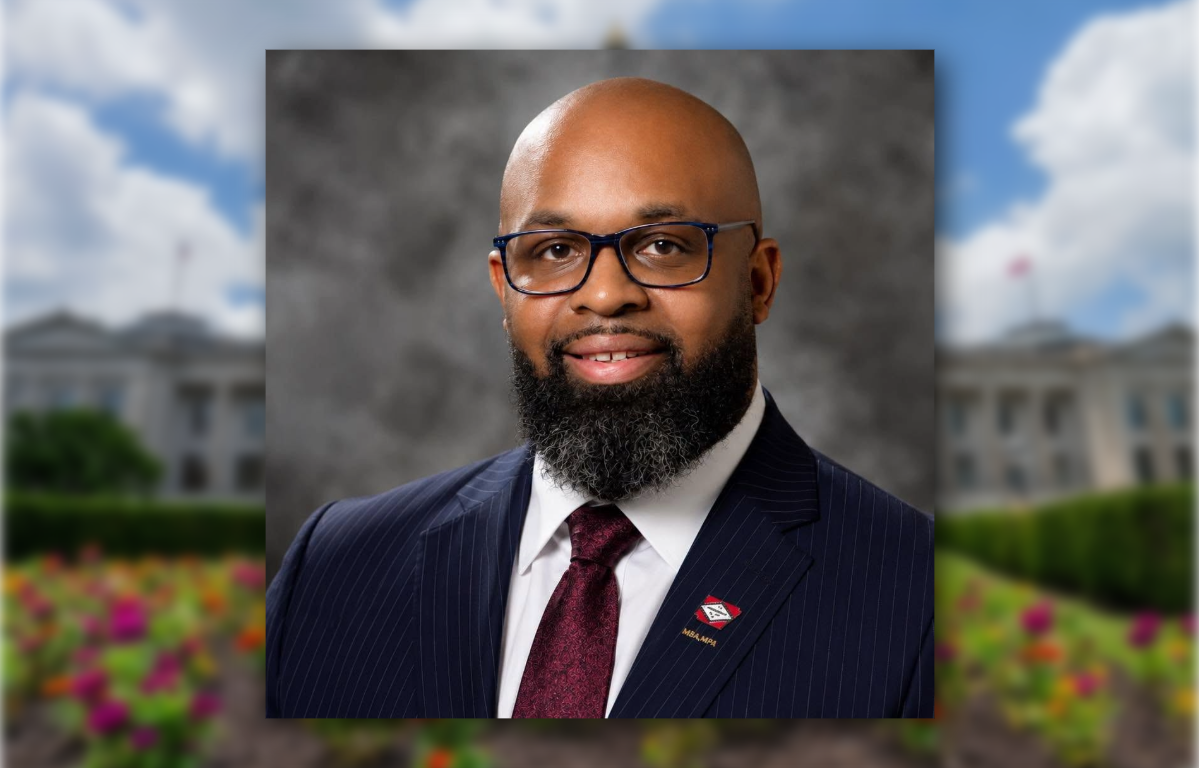

Jonesboro, AR – Jonesboro Right Now – On Thursday night, what was billed as a political debate for the Arkansas House of Representatives District 36 race quickly transitioned into a solo town-hall-style forum.
Democratic challenger Shamal Carter was the sole candidate to take the stage at the ASU-TV studios, fielding questions for the duration of the broadcast. Debate organizers noted that the Republican incumbent, Rep. Johnny Rye, was invited to participate but never responded to the invitation.
Moderated by KASU Program Director Marty Scarbrough, the altered format gave Carter the uninterrupted floor to articulate his campaign’s “people over politics” platform to a panel of journalists, addressing a wide range of economic, educational, and rural infrastructure issues ahead of the 2026 election.
In his opening remarks, Carter outlined the foundational philosophy of his campaign, noting that he entered the race 15 months ago. He stated that he has spent that time traveling extensively throughout District 36, stretching from Jonesboro to Lepanto, to connect with voters directly.
Describing himself as a father, grandfather, music minister, and community leader, Carter emphasized his desire to shift the legislative focus in Little Rock. He argued that it is time to prioritize “people over politics” by concentrating on the everyday needs of citizens rather than partisan agendas.
Taxation, the State Budget, and Agricultural Policy
Laganzie Kale, founder and general manager of Jonesboro radio stations KLEK 102.5 FM and Glory 104.3 FM, opened the panel’s questioning by pressing Carter on the state economy.
When asked if he would advocate for altering taxes and how he planned to fund additional state investments without creating a deficit, Carter firmly opposed any tax hikes.
“Right now, we’re taxed hard enough,” Carter said. “Affordability is an issue that’s affecting everybody, not just Democrats but Republicans as well. So, no, I do not raise taxes”.
| ADD US ON GOOGLE NEWS: Click here to see more local news from Jonesboro Right Now
To fund necessary state investments, Carter pointed directly to the existing budget, specifically highlighting the state’s educational spending.
“I look at us having $3.7 billion in our education budget, yet we’re pulling almost a half a billion dollars from our general funds in order to pay for education, those EFA [Educational Freedom] accounts,” he said.
Instead of raising revenue, Carter proposed a shift in management: “We repurpose money, we reallocate money, and we cut where cuts are needed, but we don’t cut where services are actually hurting our citizens here in Arkansas, especially Northeast Arkansas and in District 36”.
Kale then pivoted to agriculture, asking Carter to detail what his previously proposed “state-level Farm Bill” would actually contain. Carter acknowledged his limitations while outlining a collaborative strategy.
“I’m not an expert. Far from an expert,” Carter admitted. “But I’m willing to sit down and build a coalition of farmers and understand the needs that they have”.
Describing himself as “a strong proponent of giving a hand up and not a handout,” Carter explained that his legislative plan consists of “building a coalition of people who understand the needs and then taking those needs back to Little Rock and working with other legislators across the aisle to build that bridge in order to fix the issues that we have in the farming industry”.
Data Centers, Infrastructure, and Higher Education
The questioning then shifted to KASU FM News Director Samantha Mitchell, who asked Carter about the recent wave of large data center investments across Arkansas.
Mitchell questioned what factors Carter would weigh if asked to support state incentives for a data center in Northeast Arkansas or District 36. Carter deferred directly to his constituents on the matter.
“I believe the power is in the people,” Carter said. “It’s not my decision ultimately. It’s the people of District 36”.
He stated his first action would be hosting a town hall to hear residents’ concerns before consulting experts to evaluate “the harmful effects, the positive, the pros, the cons”. Carter pointed to recent legislative missteps, specifically criticizing Act 373.
“Act 373 requires the customers in the area to pay a tax to help build the infrastructure for data centers,” Carter noted, arguing that his constituents voted for affordability, not new taxes to subsidize private tech infrastructure. “I learned from them: come talk to us before you make a decision,” Carter said, adding that he would abstain from voting on sudden, immediate legislation until the community was properly consulted.
Mitchell followed up by asking how Carter balances the state’s growing emphasis on high school career and technical education—designed to push students into the workforce earlier—with the need to keep four-year degrees from institutions like A-State valuable and accessible.
Using the region’s prominent steel industry as an example, Carter warned against the hazards of sending youth straight into heavy manufacturing without proper maturity or education.
“The steel industry, like I said, is one of the most dangerous that you will go into,” Carter explained. “You get an 18-year-old fresh out of high school who doesn’t understand the importance of workplace safety”.
| ELECTION COVERAGE: Click here for more about what you need to know for the upcoming election
While he fully supports technical certifications, Carter strongly encouraged pairing them with higher education to maximize long-term earning potential.
“Yes, I’m pushing for you to get that certification, but I also think once you get that certification, you should also utilize a four-year institution like the one we have right here, Arkansas State University, to build your credentials,” Carter stated. “That $50,000 you may have made coming out of high school turns into 120, 130, 140, 150 because you have more credentials behind your name”.
Carter then shared a personal connection to the university, noting his grandfather’s history there.
“Arkansas State University is where my grandfather worked the grounds at,” he reflected. “Beyond working the grounds here, I was able to walk these halls because he worked the grounds”.
University Partnerships and Workforce Retention
The panel then turned to Allie Carson, editor-in-chief for the Herald, who asked how Carter would strengthen the relationship between the university and the surrounding Northeast Arkansas community. Carson also pressed him on strategies to retain graduates in the local workforce.
To bridge the campus and the community, Carter stressed his strategy of coalition-building. He proposed bringing local manufacturing and healthcare industries together with university departments to align educational programs directly with local job demands.
When it comes to keeping graduates in Northeast Arkansas, Carter argued that the key is “workplace readiness”. He strongly advocated for expanding hands-on internship programs that integrate students into the local workforce before they even receive their diplomas.
“I can’t be prepared for work day one after I graduate college if I haven’t had internships,” Carter noted, explaining that early exposure to the workplace helps young professionals build roots in the area. “How can I lead until I first follow? I have to get in a position to where I can follow where I’m going, and then once I graduate and I go into the position, I can be a leader because I’ve followed the instructions of those who have done it many years before me”.
Overcoming the Odds and Rural Healthcare Infrastructure
Levi Seward, president of the A-State Pre-Law Club, brought the conversation to the political realities of District 36. Pointing out that a Democrat lost the district to incumbent Johnny Rye by a nearly 36-point margin in 2024, Seward asked what makes Carter’s campaign different.
Carter responded that his 15 months on the campaign trail have allowed him to look past partisan divides and focus on urgent, practical crises.
“I think I’ve been more focused on why we’re the most hungriest state. I have been more focused on why, when it comes to education… we rank at the bottom,” Carter said. “Yes, I’m a Democrat through and through, and I say people over politics… but I think I’ve been more focused on trying to find solutions to make life better for Arkansans all over the state of Arkansas, but specifically District 36”.
Seward followed up by asking for one specific policy Carter would champion for the rural, shrinking Delta towns in the district, such as Lepanto.
Carter immediately pointed to healthcare access as a critical failure for rural residents. He noted that in an emergency, Lepanto residents are forced to travel vast distances to hospitals in Memphis or Jonesboro.
“When it comes to healthcare, it doesn’t matter what party you’re with. Everybody gets sick, whether you’re a Democrat, Republican, independent… everybody gets sick,” Carter said. To solve this, he stated he would work across the aisle to build rural healthcare infrastructure, including funding for ambulance services, helicopter pads, and expanded telehealth access.
Closing Argument to Voters
In his closing statement, Carter challenged voters to look at their own financial realities when heading to the polls.
“Do I have more money in my bank account than I did 10 years ago? Am I better off today than I was yesterday? We don’t have to go back 10 years to see that,” Carter asked the audience.
He highlighted his background in community service—feeding families and organizing holiday turkey drives—to contrast himself with career politicians.
“Those were all things that I done before I decided to run for office. I’m not a politician,” he said. “It doesn’t matter what my party wants, it’s what the people want”.
Carter concluded by promising to be a transparent advocate in Little Rock, particularly regarding how taxpayer dollars are spent on education, pledging to fight for policies that benefit the public rather than private interests.
The ASU-TV next debate will be at 6 p.m., Thursday, Oct. 8. for the U.S. House District 1 race between Republican incumbent Rick Crawford, Democratic candidate Dr. Terri Yarborough Green, and Libertarian candidate Dr. Steve Parsons. ASU-TV confirmed that Crawford will not be participating in the debate, but Green and Parsons will be present.
You can re-watch the District 36 debate and watch the future debates by going to ASU-TV’s YouTube channel.
| DAILY BRIEF: Sign up for the Jonesboro Right Now Daily Brief Newsletter