


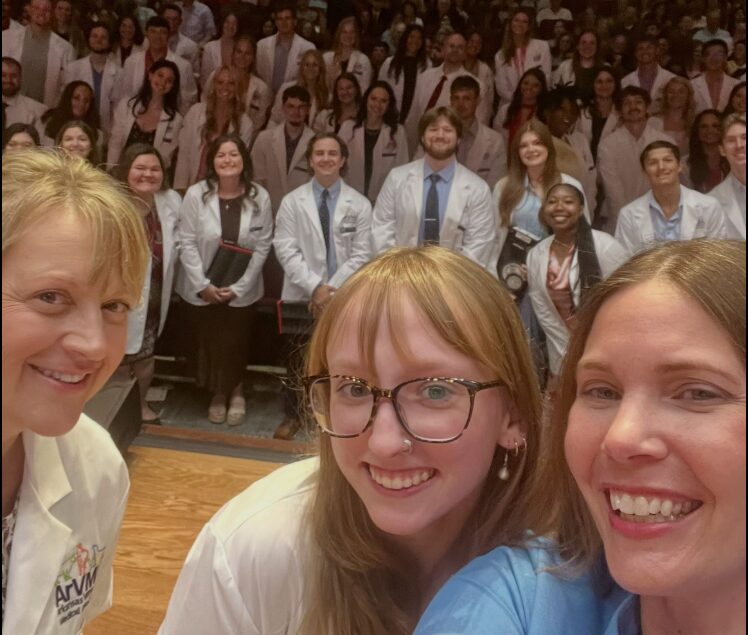

Jonesboro, AR – Jonesboro Right Now – There was no class ahead of them.
No second-year students to offer advice about the first round of exams. No third-year students to tell them which professors to watch out for. No fourth-year students to show them how things are supposed to be done.
There wasn’t even an alumni association to join.
There were only about 120 students, a brand-new veterinary college and a white coat waiting for each of them.
On Saturday, Arkansas State University’s inaugural College of Veterinary Medicine class officially became the first group of veterinary students to wear those coats. And in doing so, they became something else: the people who will forever be able to say they were first.
“This is it,” said Dr. Will McLean, A-State’s interim provost and executive vice chancellor, as he addressed the students during the White Coat Ceremony. “Every college has a first class. Every tradition has an origin. Every legacy has a beginning. Today, that beginning belongs to you.”
It was a message repeated throughout the ceremony. The students aren’t simply the first to receive a veterinary education at A-State. They are the people who will help establish the culture, traditions and reputation of a college that university officials have spent more than a decade working to create.
McLean told them that someday, when future students walk the halls of the College of Veterinary Medicine, those students will know that the institution began with the people sitting in front of him Saturday.
“Everything this college will become, its reputation, its research, its impact on the animals and the people who love them, begins with the people sitting before me today,” McLean said.
That is a remarkable responsibility for a group of students who, only days earlier, were simply beginning veterinary school. It is also why Saturday’s ceremony was about considerably more than putting on a white coat.
A coat, a promise and a beginning
The white coat is a familiar symbol in medicine. For these students, however, it carried the additional weight of being the first.
Dr. Heidi Banse, founding dean of the College of Veterinary Medicine, told the class that the coat represents a promise — not just to learn how to diagnose and treat animals, but to understand the people who bring those animals through the door.
“You are not only entering an animal-centered profession, but also a people-centered one,” Banse said.
Banse illustrated that point with a story from her own veterinary training. As a fourth-year student, she found herself caring for a critically ill dog whose elderly owner felt guilty that the animal’s condition had gone unnoticed.
Banse spent five days caring for the dog in an intensive-care unit, including feeding it by hand, while developing a relationship with its owner. The experience changed the way she viewed the profession.
Although she entered veterinary medicine to take care of animals, Banse said she learned that veterinarians must also learn to take care of the people connected to those animals.
That lesson was echoed throughout Saturday’s ceremony.
McLean told the students that somewhere in Arkansas, a farmer may already be checking on a sick calf and worrying about what it could mean for a season’s income. Somewhere else, a family may be concerned about an elderly dog that has been part of their children’s lives for years. And somewhere, a public health official may be watching for a disease that could move from animals to people.
Those people, he said, are waiting for the veterinarians these students will eventually become.
Not today.
But four years from now.
“The work you begin today has a reach far beyond one exam room or a clinic,” McLean said. “It reaches into food security, into public health, into the bond between humans and the animals we love and live alongside.”
The students then stood together and recited the student veterinary oath, pledging to develop their scientific knowledge and skills for the benefit of society through the protection of animal health, relief of animal suffering, conservation of animal resources, promotion of public health and advancement of medical knowledge.
Then came the moment everyone had been waiting for.
One by one, the members of Vet Pack 2030 walked forward. One by one, they put on the white coats that will eventually lead them to a DVM degree in 2030.
A mentor’s lesson comes full circle
For Dr. Sarah Schedenhelm, the ceremony was personal long before she stepped to the podium.
Schedenhelm, president of the Arkansas Veterinary Medical Association, is an Arkansas native from Cotter. She once sat in an A-State classroom herself, first taking night classes at Arkansas State University-Mountain Home before earning her undergraduate degree in animal science in Jonesboro. She later earned her Doctor of Veterinary Medicine from Louisiana State University.
But some of the lessons that shaped her career weren’t learned in classrooms. They happened in a truck.
Schedenhelm told the students about her first veterinary mentor, Dr. Rodney Vaughn, who took her along on farm calls while she was a student. They drove through the Arkansas countryside, making calls and talking about veterinary medicine, life and what it meant to become the kind of veterinarian she wanted to be.
Those experiences, she said, helped shape not only how she would practice veterinary medicine, but the veterinarian she would become.
And then Schedenhelm looked into the audience.
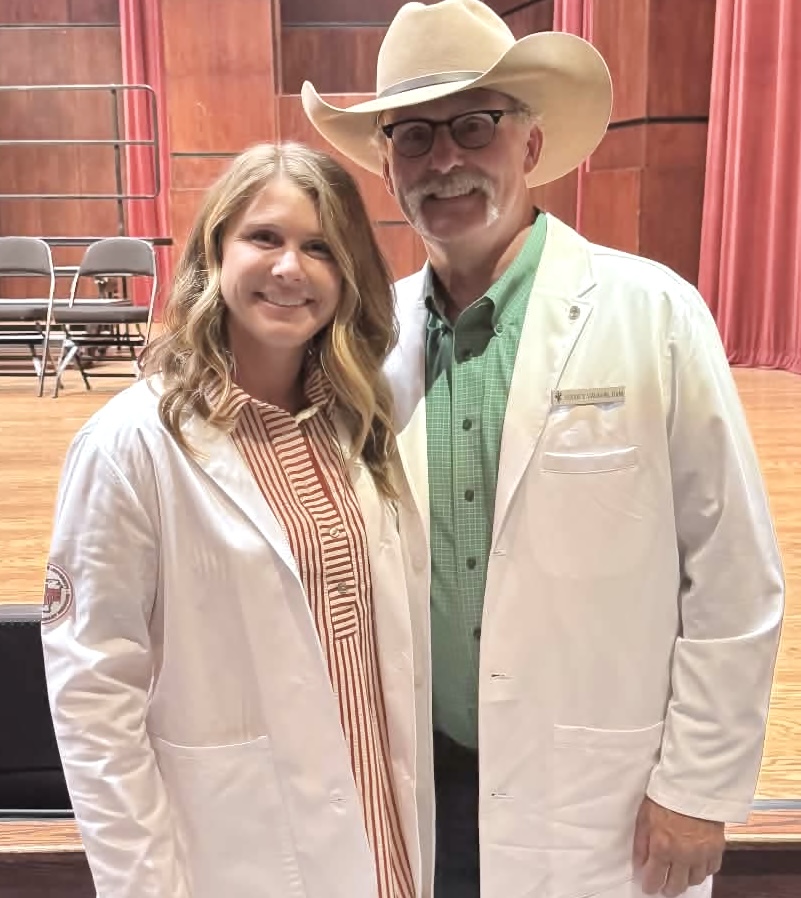
Rodney Vaughn was there. So was his daughter, Caraline.
Caraline is one of the students in A-State’s inaugural veterinary class.
Schedenhelm had written her speech before she knew that Vaughn’s daughter would be sitting among the students. She pointed him out from the stage.
“Rodney, I don’t know where you are out there, but oh, there you are,” she said.
The moment drew a smile from the room, but it soon became even more meaningful.
Caraline would walk across the stage herself.
And her father — the same veterinarian who had once taken Schedenhelm on those farm calls — would help put the white coat on his daughter.
A lesson passed from one generation of veterinarians to another, in the very first class of a veterinary college that didn’t exist when Schedenhelm was an A-State student.
For a ceremony built around being first, it was difficult to find a better illustration of what that really means.
They aren’t just starting something. They’re building it.
Schedenhelm told the students that their class will be remembered long after they leave A-State.
“You were the first to walk through these doors, but you certainly won’t be the last,” she said.
That distinction matters.
Future students will inherit traditions this class creates. They will learn in facilities these students helped put to use. They will benefit from relationships and partnerships established during these first four years.
And eventually, they will walk into a college with a history.
This class is the beginning of that history.
McLean acknowledged that being first won’t always be easy. There will be growing pains. Some procedures will have to be developed as the program moves forward. Some traditions will have to be invented. Some things won’t work perfectly the first time.
But that, he told the students, is part of the privilege of being first.
“You are not simply receiving an education,” McLean said. “You’re helping to build something.”
That something is the latest chapter in an effort more than a decade in the making.
What once existed as an idea on paper is now a veterinary college with a faculty, facilities and its first full cohort of students.
And on Saturday, it became something more tangible still.
It became a group of students wearing white coats.
Schedenhelm reminded them that they haven’t earned the title of veterinarian yet. But they have accepted the responsibility of pursuing it.
“Wear it with humility and compassion,” she told them. “Wear it knowing that every veterinarian in Arkansas is cheering for you.”
Four years from now, another class will likely be sitting where they sat Saturday. By then, there will be students ahead of them. There will be traditions. There will be alumni. There will be a history.
But there will only ever be one first class.
And on Saturday in Jonesboro, the first class of Arkansas State University’s College of Veterinary Medicine put on its white coats and began writing that history.