


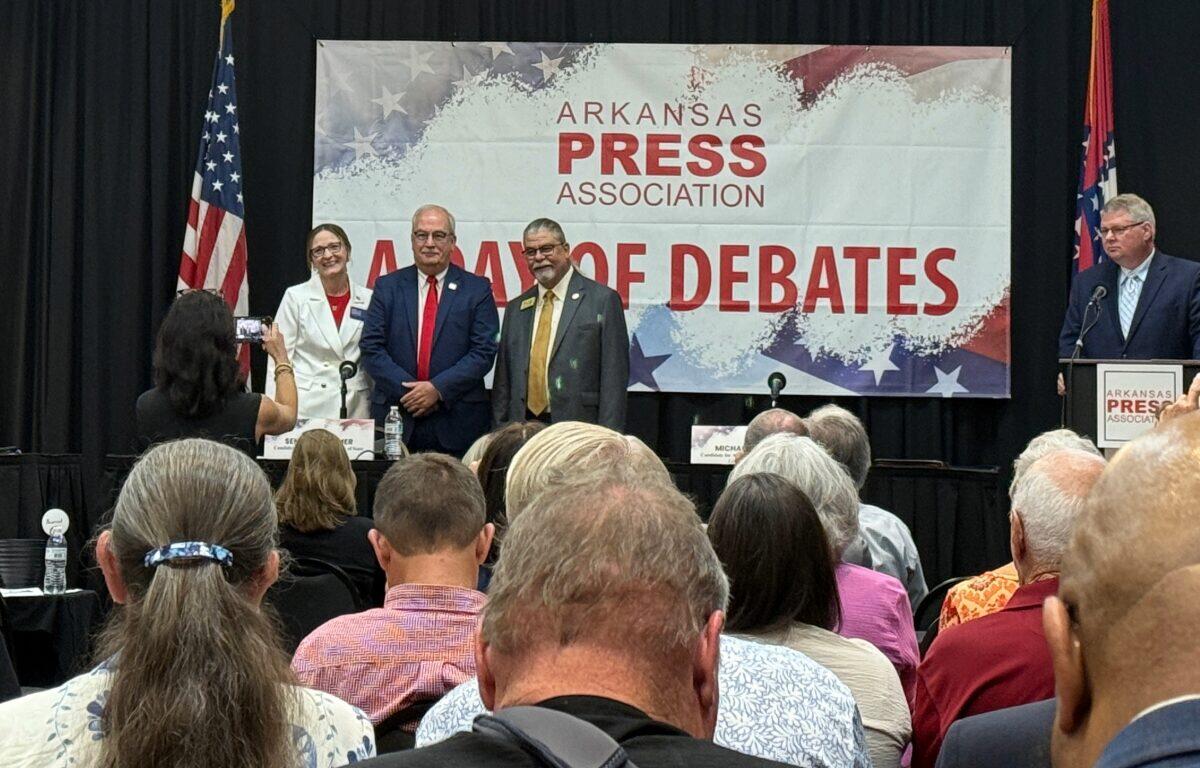

Eureka Springs, AR – Jonesboro Right Now – Ahead of the upcoming election, candidates for Arkansas Secretary of State recently gathered to clarify their skills, values, priorities, and experience for voters.
The debate, which featured Dr. Michael Pakko (L), Kelly Grappe (D), and state Sen. Kim Hammer (R), was hosted by the Arkansas Press Association. Questions were prepared in advance by the association’s working media members. The moderator of the event was Andrew Bagley, co-owner and publisher of The Helena World.
Grappe led the opening remarks, focusing heavily on rebuilding trust. “People deserve to have a government who trusts them. People deserve to be able to trust in their government,” she said.
| ADD US ON GOOGLE NEWS: Click here to see more local news from Jonesboro Right Now
She underscored the foundational role of the Secretary of State office, adding, “It’s the first time many people get to touch our state government. And when people come and do business with our state government, they need to have confidence. They need to have confidence that their vote is secure. They need to have confidence that their signature counts when they sign a petition.”
Pakko, an Arkansas economist and chairman of the Libertarian Party of Arkansas, followed with a critique of the two-party system. “I’ve seen how the system is rigged,” Pakko said. “Our system of laws, practices, and traditions gives enormous power to the two major political parties.”
Pakko argued that the current climate forces a binary, fear-driven process, asserting that “elections are too important to leave to the Democrats and Republicans.”
Hammer, who has served 16 years in the Arkansas Legislature, concluded the opening remarks by highlighting his background in business and government. Hammer pointed to his extensive legislative tenure, claiming it “has contributed to us being the number one state in the nation as far as election integrity and security.”
The debate then shifted to election security and whether Arkansas faces problems warranting a return to paper ballots.
Hammer spoke first, defending the state’s current trajectory. “I am not in favor of paper ballots,” Hammer said. “We have a good election process right now.”
Pakko agreed that the state’s electronic tabulating devices are secure, noting they proved accurate in a recent recount. He added that hand-marked paper ballots are largely unnecessary since existing electronic methods provide a verifiable paper trail, though he suggested that “maybe we need a better technology for the voting machine reader to read actual text rather than just barcodes.”
Grappe expressed confidence in local election officials but emphasized that the state cannot simply ignore public skepticism. “Arkansas is rated the worst in the country as far as our civic index,” Grappe said. “That’s not okay with me. I think that’s a failure.”
The candidates also clashed over the state’s citizen-led referendum and petition process, specifically whether recent legislative changes restrict grassroots access. Pakko directly criticized 2025 legislation sponsored by Hammer.
“The raft of legislation that was sponsored by Sen. Hammer in the 2025 session represents a direct assault on the principle of ‘regnat populus’,” Pakko said. The state motto of Arkansas, regnat populus, is Latin, meaning ‘the people rule.'”
Pakko argued that the new restrictions make the process nearly impossible for volunteers, playing into the hands of deep-pocketed interests.
Grappe agreed that the state’s initiative process is sacred but argued that current laws stifle volunteer efforts. “Right now, there’s too much money in the system because it’s too tough to get it done without the money, and there’s not enough people because the people are fearful about the process because of some of these new laws,” Grappe said.
Hammer defended the legislation, stating it was a team effort designed to protect the state constitution from being “pimped out” to the highest bidder. He asserted that initiatives should face the same verification standards, such as voter ID requirements, as regular voting.
On federalism, all three candidates firmly rejected federal intervention in state elections, citing federal proposals such as the SAVE Act. (The Safeguard American Voter Eligibility (SAVE) Act is a federal bill that would change how Americans register to vote.)
“Our U.S. Constitution says that the states are in charge of our elections. Period,” Grappe stated.
To improve Arkansas’s low voter turnout, Grappe called for public education. Hammer proposed reintroducing comprehensive civics classes in schools, while Pakko advocated systemic changes, such as ranked-choice or instant-runoff voting, and increased political competition, particularly from parties beyond the Democratic and Republican mainstream.
In closing statements, Pakko rejected the notion that voting for a third party is a wasted vote, urging Arkansans to vote Libertarian to signal a desire for real systemic reform.
Hammer focused on his administrative readiness, pledging to maintain regular communication with the press and the public.
Grappe closed by calling for an end to political polarization and a renewed focus on the state’s neglected rural communities. “We’ve got to come back to talking to each other again,” Grappe said.
Voters will make their final decision at the ballot box this November. Information on Craighead County elections is available online, and registration status can be found at the Secretary of State’s website.
Voter registration forms are available at the County Clerk’s Office at 511 S. Main St., Suite 202, Jonesboro. You can also call the County Clerk’s Office at 870-933-4520 to check your voting status.
The full debate will air on ArkansasTV on July 1 at 6 p.m. and will be available online.
| DAILY BRIEF: Sign up for the Jonesboro Right Now Daily Brief Newsletter