



Jonesboro, AR – JonesboroRightNow.com – The Craighead County Quorum Court approved two ordinances Monday night regarding the proposed consolidation of the county treasurer and collector’s offices.
The first ordinance was to accept the results of a study to see if combining the two offices would be effective. The study, authored by county attorney Kimberly Dale, concluded that the consolidation would be an efficient move with proper checks and balances.
The second ordinance places the issue of consolidating the two offices on the November ballot, with voters to ultimately approve or strike down the issue. If voters approve the consolidation, the two offices would not be combined until January 2031.
In previous presentations of the proposal, Craighead County Judge Marvin Day advocated for the consolidation, saying it could save the county around $150,000.
During the Quorum Court’s discussion of the ordinance to approve the study, Justice of the Peace for District 4 Linda Allison asked why additional information regarding the study had not been provided. She requested to table the ordinance until additional information, such as insight from other organizations and county governments on the pros and cons of the consolidation, is provided.
“I’ve only seen that we’re going to potentially save money, but we’re not going to potentially save money because we’re looking at [a] potential auditor or comptroller, and I just want to know, one of my questions would be ‘Where does this end?'” Allison said. “If we eliminate this, then are we going to be turned around after this ends and be now hiring a comptroller? I mean, what is the long-term goal on how we’re gonna maintain some auditing within our organization?”
Allison also asked how an oversight board that oversees deposits and bank accounts, which, for Craighead County, includes the collector, treasurer, and the county judge as members, would be affected if the offices were consolidated. Day said he would have to consult the statute to see what would happen regarding the makeup of that board.
Day said that the Quorum Court approved the initial study, which was to cost no more than $5,000. He added that Pulaski County, which is the largest county in Arkansas, has a consolidated office. He added that, while that government might have a larger staff, he was not looking to create a bureaucracy in Craighead County.
“Can we get by with one less elected official that would free up some money that we could hire an auditor? I’m not looking for a comptroller, that doesn’t make sense to me,” Day said. “But an in-house auditor that reports to you, think about that for a minute, that reports to you, the Quorum Court, is hired and fired. If they’re not doing their job, they can be hired and fired by the Quorum Court. That makes sense to me.”
Day added that the proposal would improve government efficiency.
“If you make it where it’s all under one roof, that it is one elected official’s responsibility through the deputies and chief deputies authorized by this court, have that responsibility of taking in that money, receiving it, and sending them a check. Then all of a sudden, there is one less risk that the tax-receiving entities have to do that,” he said.
Garrett Barnes, Justice of the Peace for District 2, said he was concerned about how the study did not mention the Legislative Audit. He said the county’s current framework, with a collector and a treasurer, had received 11 consecutive reports with no negative findings.
“I think that’s pretty effective to go 11-for-11 without any negative findings on that position or its staff. So, I don’t see how that can be improved more and be more effective than having 11 in a row,” Barnes said.
Justice of the Peace for District 6, Darrel Cook said if the measure passed, then an internal auditor would be needed once it passes, not in four years when it becomes effective. He said the county’s budget could be “fine-tooth combed” to find the money for an auditor. He asked Day how much an auditor would cost now that the county’s wages had been increased, asking if $100,000 could hire an auditor. Day responded, “Probably.”
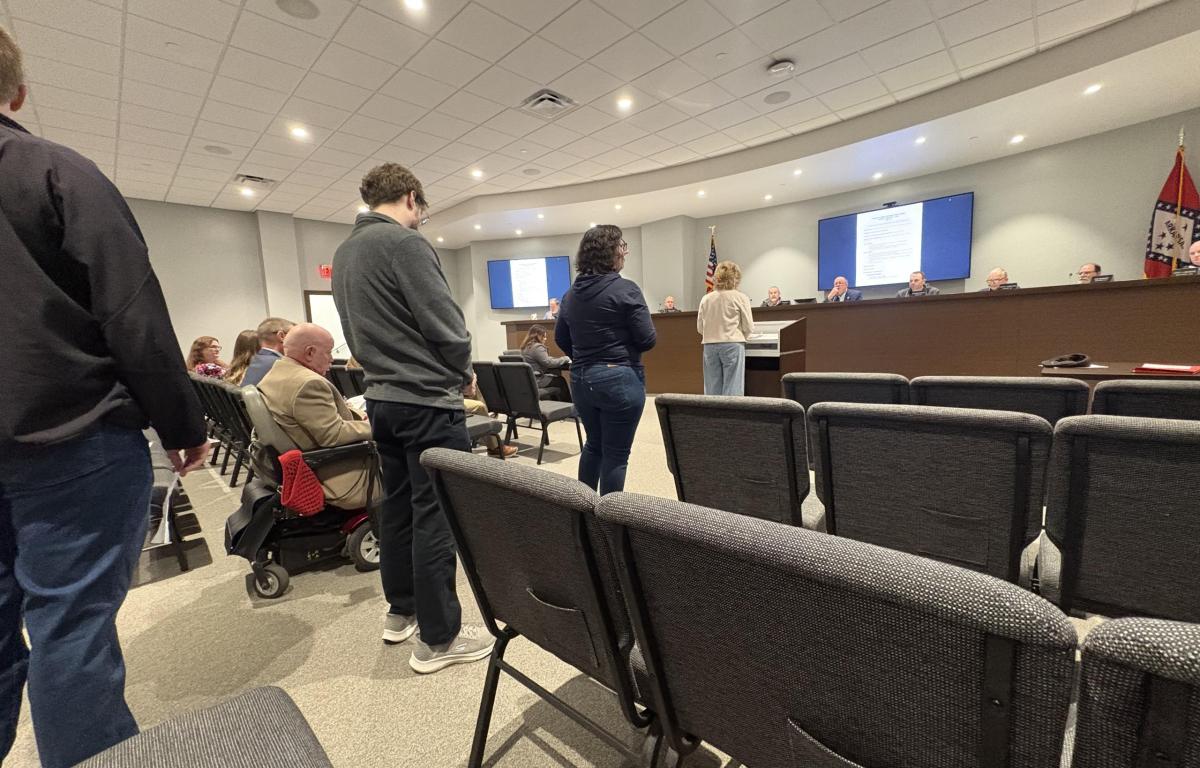
Several members of the public appeared Monday night to speak against both ordinances. Public commenters said they felt the initial study on the consolidation lacked data and was not comprehensive enough, while others said the county would have to hire an auditor if the positions were combined, ultimately not saving money. During previous discussions of the ordinances, some Quorum Court members voiced similar concerns.
Jolene Mullet said she was concerned about an increased workload if the two positions were combined, which could be overwhelming.
“I feel like the potential for burnout for that position would maybe be higher as well, which leads to my next point, that the large workload could lead to more mistakes, which I know none of us want,” Mullet said.
Robin Martin cited Arkansas Code 14-14-606, which outlines requirements governments must follow if changes to governmental structure are to be made. According to the law, a comprehensive analysis must show improved efficiency, effectiveness, responsiveness, and accountability to the public.
She said those four things were not listed in the analysis, and it should not be approved.
Iris Stevens, coordinator for the Northeast Arkansas Tea Party, said the organization was “very concerned” about the issue and did not want it to move forward.
“To come up with the idea that would eliminate an elected position here in Craighead County and substitute a bureaucratic position, and that’s what you would do if you eliminate the treasurer or the collector and you combine those offices,” Stevens said. “And then, you’d hire a comptroller. Comptroller is a bureaucratic position, not [an] elected position.”
Ross Kerley said he felt the study was misleading, referencing comments Martin had made during previous presentations of the measure. He said Martin pointed out that part of the analysis, in which comments from the Sebastian County judge saying that their government’s previous consolidation worked because it had a comptroller, were removed from the study.
“I think it’s intentionally misleading that it was left out of your published analysis. That analysis was all pro, and no cons or tradeoffs were listed,” Kerley said.
The ordinance to approve the study passed 8-5, with Justices of Peace Steve Cline, Terry Couch, Barry Forrest, Josh Longmire, Rick Myers, Brad Noel, Richard Rogers, and Kevin Williams voting for it. Allison, Barnes, Cook, and Justices of the Peace Dan Pasmore and David Tennison voted against it.
During the discussion of the ordinance proposing an election for the consolidation, Cline said he felt the need to allow voters the opportunity to vote on the issue. He said if the public had enough “enough smarts” to vote on constitutional amendments and other political offices, they had enough “enough smarts” to vote on the consolidation proposal.
Barnes said he was concerned that this was the second consecutive time an issue without “a detailed plan with it or what folks could expect to get” was being put before voters.
Williams spoke in favor of putting the issue before the voters, saying he felt he couldn’t take away the public’s option to vote on the matter. “How do you say ‘no’ when the public didn’t get to vote on it?” he asked. “I think it needs to go there.”
The Court also passed the ordinance to send the proposed consolidation to the ballot. It passed 8-5, with Cline, Couch, Forrest, Longmire, Myers, Noel, Rogers, and Williams voting for it. Allison, Barnes, Cook, Pasmore, and Tennison voted against it.
The full meeting can be viewed here.