


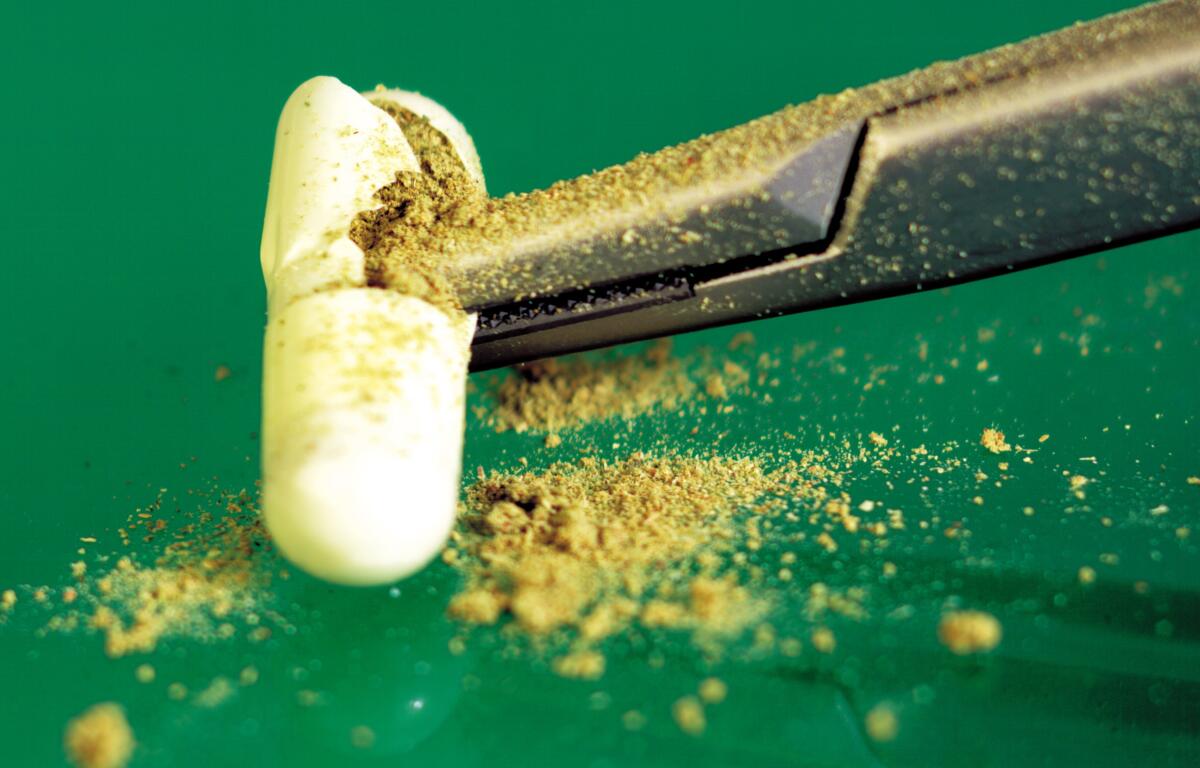

Jonesboro, AR – (JonesboroRightNow.com) – A simple green powder marketed for “extra energy” has become a nightmare for two men, leading them into a spiral of addiction even as the state continues to debate the future of the controversial substance.
In 2016, Ralph Oglesby, III was in Missouri when he pulled into a service station. He had been working for 24 hours straight at his construction business and needed to boost his energy.
He typically relied on five-hour energy drinks, but the service station was out, so a staff member offered him an alternative.
“‘We just got this the other day, and it’s [a] cousin to a coffee bean.’ It said ‘natural energy,’ and it was three pills in this pack,” Oglesby related to JRN.
“It was straight kratom,” he added.
According to the United States Food and Drug Administration (FDA), kratom is a tropical tree native to Southeast Asia. As a supplement, it’s sold over the counter and online and used to help with pain, anxiety, depression, opioid use disorder, and opioid withdrawal. A survey by the Substance Abuse and Mental Health Service Administration found that 1.7 million Americans ages 12 and older used kratom in 2021.
For Oglesby, that first pill for energy turned into a full-blown addiction within five years that included taking kratom in both pill and shot form, which he claimed was more expensive at $15 a piece.
“So for the next three-and-a-half years, I was taking 100 of the powder half splits a day, plus five to eight of the shots,” Oglesby said.
Before taking kratom, Oglesby said he had never smoked and had only drunk two beers in his life. Kratom became a gateway to marijuana, a drug he still struggles with.
Designed Addiction
The FDA warns against using kratom. The substance has serious side effects, including liver toxicity, seizures, and substance use disorder, among others. The primary offender in kratom is 7-Hydroxymitragynine, or 7-OH, a byproduct of kratom leaves.
According to the FDA, 7-OH occurs in botanical kratom at a very low amount (approx. .01 to .04 percent by dry weight). However, the chemical causes feelings of euphoria and has been described as 13 times more potent than morphine.
A synthetic version of 7-OH has become increasingly available in the United States, and it’s potently addictive.
For Oglesby, as his doses increased, so did the costs. Before he sought help in November 2025, he was taking between 500 and 700 milligrams a day, costing him $125 to $200. Although he would usually buy a stock upwards of three to four days, Oglesby said he would consume the pills all in one day.
“There was no stopping [it],” Oglesby said. “This is something that’s like a slow-eating cancer. It just keeps taking a little until you’re totally out of control.”
Oglesby said his addiction to kratom forced him to sell his house and construction business in April 2023, with the intent of ending his life.
“We bought 15 acres, and I set a trailer house up for my wife, with [the] intent to follow through at the first of this year,” said Oglesby. “When I was bent over one day, my hat fell off, and [my wife] saw a large gaping hole in the top of my head, and she said, ‘What’s going on?’ I broke down, and I told her what had been going on, and that’s where all of our money is.”
Recovery Road
Oglesby’s wife knew he needed help. He went to Tijuana, Mexico, in November to an ibogaine clinic for treatment, which he said helped tremendously.
Ibogaine is a psychoactive substance often used for treating addiction. It has not been used in the United States since 1970, when it was classified as a Schedule I drug, according to Stanford Medicine.
“I took 33 bags of IVs in six days, no running water. I was there with 10 other people, and they had us taking morphine every four hours to come off the kratom for seven days to do the ibogaine experience to try to recalibrate the brain,” Oglesby explained.
Oglesby said things still haven’t been easy, as his road to recovery is in the early stages. He still has the urge to go back to kratom, even after the ibogaine clinic visit. He added that his mental health has been impacted more than his physical health. He said his mind is still confused. Because of the dangers of kratom, Oglesby is passionate about getting the word out to others about how addictive the product is.
“If you have an addictive personality, you better never try it at all,” Oglesby said.
If Oglesby’s situation does not improve by the end of January, he said he will look into a short-term recovery place to help.
“I’m looking at Nashville, at Treehouse Recovery. They’ve dealt with a lot of kratom,” Oglesby said. “I want to get back to construction work and just love my wife and my family. I want to be back 100% in the game.”
Not an Isolated Addiction
A mother of an adult child, who wished not to be identified, told JRN her son also faces a struggle with kratom.
She has two sons. Her oldest had struggled with other drug addictions and issues with the law for years, when she learned her younger son was addicted to kratom.
“He was raised around some family abuse,” she said. “There was abuse in the home, and once we got divorced, I started working to rebuild what I could.”
She said her son, who is now 34, works in Tennessee and commutes to Arkansas. He had struggled with drinking since high school, but around six to eight months ago, he decided to quit alcohol. That’s when a friend offered him a kratom pill for energy.
“I’d noticed a change in him. His wife even noticed a change in him, and she said, ‘I’m afraid he’s doing something he shouldn’t be doing,’” the mother recalled.
Sometime in early December, the mother received a text from her son’s wife, saying he’s having heart palpitations. When she talked to her son, he said he was having a heart attack.
“He got checked out. Apparently, everything was fine,” the mother said. “He confessed to his wife that he thinks it’s these pills. She said, ‘He’s confessed that he’s taking these pills, but he’s getting them at the gas station.’”
It turned out that the son was taking a 7-OH pill every three to four hours. His mother said if he didn’t take them, he would have withdrawals. “He told me it’s worse than heroin,” she said.
For now, the mother said her son is looking into detox as he tries to support his wife and children. She added that once he gets detoxed, Breaking Bonds Ministries agreed to take him.
“I’m scared for him,” the mother remarked. “He’s obviously a grown man, and in the past, when he was younger, any time there were troubles, he always called me. We’re still very close; we always have been. I’m going to help him the best that I can.”
Is it Legal?
In Arkansas, kratom is illegal. In 2016, the Arkansas Department of Health enforced the state’s decision to classify the active components in kratom (mitragynine and 7-OH) as a Schedule I substance. This puts them in the same category as drugs such as heroin, LSD, and ecstasy, which are all illegal to possess or sell in Arkansas.
Arkansas Code § 5-64-419 states that having less than two grams of kratom can result in up to six years in prison and a $10,000 fine, while having over 28 grams (one ounce) can result in five to 20 years.
Arkansas is one of only six states in the United States where kratom has been banned, along with Alabama, Indiana, Rhode Island, Vermont, and Wisconsin. Of the states that surround Northeast Arkansas, where kratom is legal, Missouri and Tennessee are the closest.
While both kratom users JRN spoke with obtained the drug from gas stations, it’s also widely sold at vape shops. JRN reached out to local vape shops for their perspective. Two agreed to speak on the condition of anonymity.
Managers from both businesses told JRN they have had customers often ask about kratom, usually when they see it being mentioned online. They said customers seeking kratom vary in age from about 20 to 40 years old and are typically surprised to find it’s been illegal in Arkansas for almost a decade.
One vape shop manager told JRN they do see the medicinal properties of kratom, adding doctors sometimes offer it to patients for dietary or mental health reasons. However, they said it is very addictive, and personally, they do not like selling it.
In April 2025, the Arkansas Senate passed a measure in a 24-5 vote to establish the Arkansas Kratom Consumer Protection Act. The measure would have removed kratom as a controlled substance and regulated it through age requirements and lab testing. However, in May 2025, the measure failed in the Arkansas House.
One vape business manager said if kratom were to be legalized, they would want lawmakers to have clear, well-defined regulations to help businesses operate responsibly. The other manager said that because they are a corporate-owned store, the decision to carry kratom if it were legal is up to the parent company, but they would give a disclaimer and tell customers about it before buying it.
A Medical Perspective
While kratom itself is dangerous, identifying kratom use also poses a problem.
Dr. Shane Speights, dean of the New York Institute of Technology College of Osteopathic Medicine (NYITCOM) at Arkansas State, said a lab would be needed to identify if kratom plays a part in a patient’s condition. He added that the effects can often depend on the type of kratom used, as it’s able to be mixed with other substances.
“It could mimic the signs of an opioid overdose, so unless the patient was forthcoming with you, in terms of what they were using and where they got it from, it could be difficult to diagnose,” Speights said. “Most of our drug screens pick up on most of the medications used in this general region.”
Because kratom is often marketed as a supplement, Speights said it bypasses how the FDA examines whether a substance is safe or not. This also means there is no guarantee that the makers have put another ingredient in the kratom.
JRN reached out to St. Bernards and NEA Baptist, with both declining to comment on this story, saying they haven’t seen any cases of kratom come through.
Side effects from taking kratom at irregular use, according to Speights, can include liver toxicity, seizures, and even death in some cases. However, he said the deaths usually occur from other substances besides kratom due to the increased potency.
If you or someone you know is struggling with substance use or addiction, help is available.
- Arisa Health – Local mental health and addiction services
- Jonesboro: (870) 972-4000
- 24-hour crisis line: (800) 356-3035
- Arkansas Crisis Center – Dial or text 988 to be connected with a trained crisis counselor for free support
- SAMHSA National Helpline – 1-800-622-HELP (4357) for treatment referrals and information
Editor’s Note: Medical professionals are bound by confidentiality laws. Seeking help for addiction at a hospital or clinic is a medical interaction, not a criminal confession.
If you or someone you know is struggling with suicide/mental health, call or text 988 to reach the Suicide and Crisis Hotline. For more suicide prevention resources, click here.